Ecomas AI vs Gorgias: Best D2C Support Tool?
Choosing between ecomas ai vs gorgias comes down to how your direct-to-consumer store handles scale. For years, established helpdesks like Gorgias defined standard e-commerce customer service by organizing messy inboxes into neat, color-coded human tickets. But consumer habits shifted fast. Today, shoppers expect instant, accurate answers at midnight without waiting in a support queue. That change has sparked an urgent debate over which platform serves as the best D2C support tool for modern online merchants.
Table of Contents
- The Evolution of E-Commerce Support: Native AI Agents vs. Established Helpdesks
- Ecomas AI vs Gorgias: Core Architectural Differences Explained
- How Do AI Resolution Rates and Action Capabilities Compare?
- Omnichannel Coverage: Live Chat, Email, SMS, and Social Interactions
- Integration Ecosystem and Tech Stack Compatibility
- Pricing Structure and True Cost of Scale: Ticket Tiers vs. AI Automation Fees
- Onboarding Friction and Setup: Time-to-Value for E-Commerce Teams
- Which Customer Support Platform Best Fits Your Store?
- The Strategic Verdict: Future-Proofing Your E-Commerce Customer Experience
Customer service in retail used to be entirely reactive. A buyer discovered a damaged package or wondered where their tracking number went. They sent an email. The email landed in a shared inbox, turned into a numbered ticket, and sat there until a tired support rep manually opened Shopify, copied a link, and pasted a canned macro response. This model works when you ship fifty orders a week. It breaks the moment holiday volume spikes or your ad spend doubles overnight.
Traditional helpdesks were built around human labor. Think of a legacy platform like Zendesk or early-stage Gorgias as an electric power tool for a carpenter. The tool helps the worker cut wood faster, but the person still builds the entire chair by hand. Every routine question requires human eyes, human keystrokes, and costly payroll hours. When order volumes explode, brands face an unpleasant choice: hire an expensive army of seasonal contractors or watch response times stretch from hours into days.
Native AI agents flip this logic upside down. Instead of handing power tools to human agents, an autonomous platform acts like a 3D printer. You connect your product catalog, shipping carriers, and store policies once. The system reads the blueprint, interacts with your business backends, and resolves the issue end-to-end without tapping anyone on the shoulder. A routine inquiry about an exchange or an order status update doesn't sit in an inbox. It gets solved in ten seconds.
Recent Reddit discussions on D2C support alternatives show growing skepticism toward older software providers bolting basic chatbots onto legacy systems. Store owners complain that many "AI-powered" helpdesks simply spit out rigid text snippets that frustrate customers and still force agents to intervene. When pitting ecomas ai vs gorgias, you aren't just choosing between two software vendors. You're choosing between managing human labor queues and running fully autonomous resolution workflows. Understanding that core divide is the first step toward building a customer experience that scales seamlessly without ballooning your overhead.
Ecomas AI vs Gorgias: Core Architectural Differences Explained
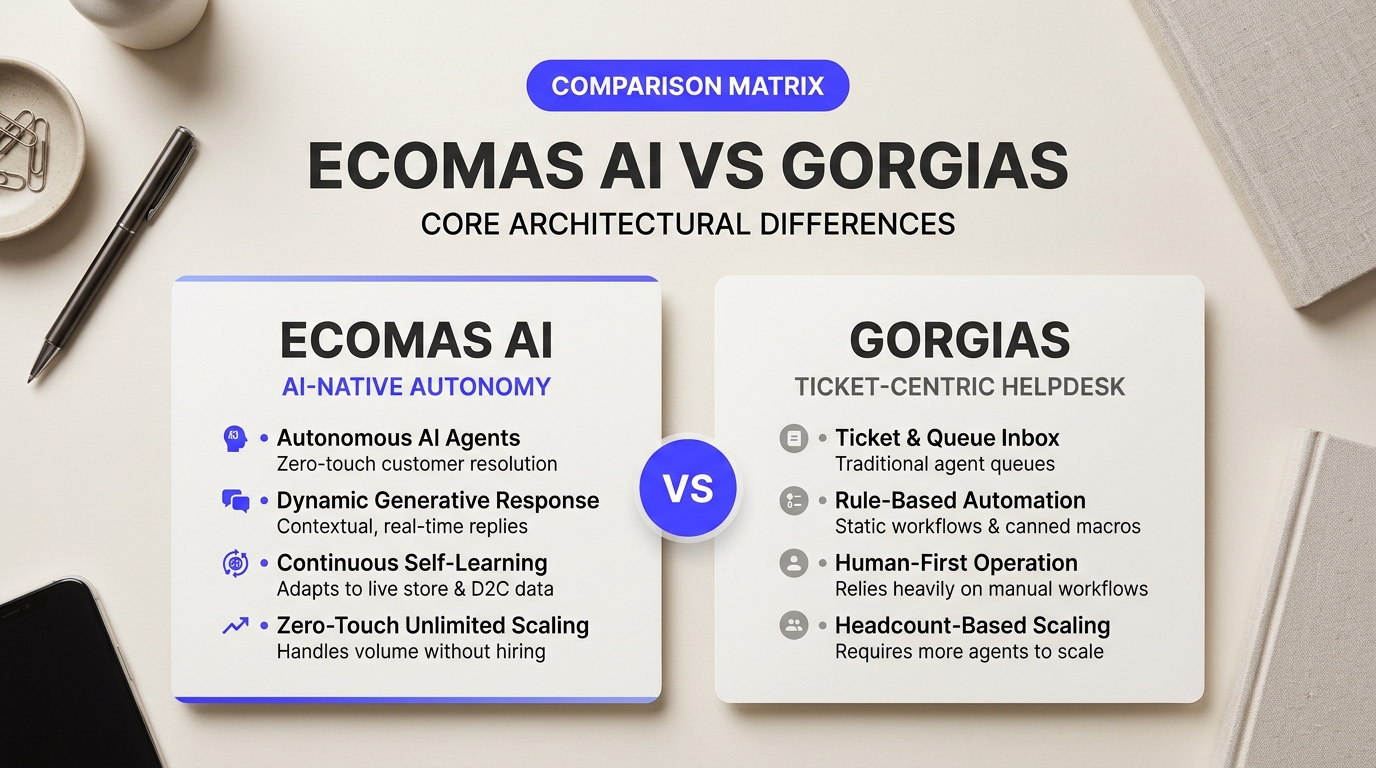
At their foundation, these two platforms view e-commerce customer service through completely different lenses. One treats customer inquiries as items on an assembly line. The other treats them as direct actions to solve on the spot. Choosing the right D2C support tool requires understanding this core split in engineering philosophy.
Gorgias began as a ticket-centric helpdesk built to aggregate messages. Think of it as a central dispatch room. Whether a shopper emails your team, pings your Instagram account, or sends a text, Gorgias bundles that inbound message into a numbered ticket. Its system gives your human agents a clean interface to respond fast, using Shopify data right beside the chat thread. Over the past few years, Gorgias introduced automated responses and machine learning add-ons to suggest macros or answer simple shipping questions. Yet, the foundational architecture remains unchanged: every interaction begins life as a ticket inside a queue waiting for human oversight or rule-based routing.
Ecomas AI takes the opposite route. Instead of building a better inbox for agents, it builds an autonomous digital operator designed to eliminate the inbox entirely. It bypasses ticket creation whenever possible. When a customer reaches out, the AI acts as an independent agent connected directly to your store backend, inventory management system, and carrier APIs. It doesn't draft a note for a human to approve later. It looks up the tracking number, verifies the customer's delivery address, modifies the order if necessary, and closes the loop within seconds.
How Ecomas AI vs Gorgias Structure Support Workflows
To see how these designs play out in real operations, look at how both systems treat a common request: an address change before shipment.
Under the Gorgias model, the customer's email lands in the unassigned folder. A macro might detect the intent and tag the ticket as urgent. If you've configured Gorgias Automate, it might send a templated response asking for the new address. But if the customer provides the info after hours, that ticket sits in line until an agent clocks in, manually updates the Shopify order, and marks the conversation resolved. Traditional platforms like Zendesk and Freshdesk share this exact queue-first design.
In contrast, when you analyze ecomas ai vs gorgias from an agentic standpoint, Ecomas AI operates via dynamic tool execution. The AI validates the customer's identity, checks whether the warehouse has already fulfilled the package, calls the Shopify API to edit the shipping record, and pings the buyer with confirmation. No ticket ever surfaces. Your human team never sees the message unless the parcel has already left the warehouse loading dock.
"Looking for genuine user experiences with Ecomas AI vs Gorgias... How does the quality and output hold up compared to manual workflows?"
— Verified store operator in Reddit SaaS discussions on AI workflows versus manual ticketing
That quote highlights the friction many fast-scaling merchants feel. Ticket queues demand bodies. When order volume doubles during seasonal spikes, ticket volume doubles right alongside it. Even with helpful canned responses, teams find themselves trapped in manual inbox triage.
| Architectural Dimension | Gorgias | Ecomas AI |
|---|---|---|
| Core Operating Unit | Support ticket in a centralized inbox | Autonomous API event / action loop |
| Default Resolution Path | Route to human agent with AI assistance | Direct autonomous resolution with human fallback |
| Backend Action Capability | Sidebar widgets for manual rep clicks | Autonomous two-way API execution without human clicks |
| Spike Scalability | Requires more seats or outsourced seasonal staff | Handles parallel volume surges automatically |
| Data Model Focus | Agent productivity metrics (first response, handle time) | Deflection, automated action completion, and cost per resolution |
Gorgias gives managers deep visibility into agent performance, shift scheduling, and macro usage. That makes it an exceptional tool for support managers running traditional contact centers. Ecomas AI, meanwhile, appeals directly to brands running lean operations where hiring ten more customer service reps simply doesn't fit the margin model. One system optimizes your human workforce; the other replaces the repetitive parts of their jobs entirely.
How Do AI Resolution Rates and Action Capabilities Compare?
A customer reaches out at midnight. They ordered a small hoodie ten minutes ago, but they need a large instead. How your customer service software handles that message reveals the core gap between a standard helpdesk and an autonomous support agent.
One platform reads the message, drops a link to your exchange portal, and closes the ticket as "deflected." The other checks your Shopify inventory, edits the unfulfilled order line item, sends a revised confirmation, and tags the warehouse queue. That distinction defines the debate when comparing ecomas ai vs gorgias on actual resolution performance.
Ecomas AI vs Gorgias: Measuring Real Autonomous Actions
Most customer support software platforms boast about high automation rates. You'll often see claims of 40% to 60% deflection. Dig deeper, and you'll find that deflection usually just means a customer didn't reply to a bot within 24 hours. That isn't a resolution. It's often just customer abandonment caused by a canned response.
Gorgias built its reputation on empowering human agents. Its sidebar widgets pull customer history into one clean view so a rep can refund an order or change an address with two clicks. When Gorgias added its AI Agent, it built on this rule-based foundation. It answers repetitive questions quickly: tracking links, return policy summaries, and discount code queries. When an inquiry requires an actual database write—like swapping a product variant—it often routes the ticket to an agent queue with a suggested macro.
Ecomas AI takes an agentic approach. It doesn't just read data; it uses authenticated API tools to perform work inside your tech stack. If a shopper asks to change their delivery address before fulfillment, the AI verifies the new address format, updates the shipping details directly via Shopify, and confirms the change in the conversation. Human intervention isn't required unless an edge case breaks predetermined safety rules.
"Our team spent half our morning just updating shipping addresses and answering 'where is my order' tickets. When a bot just links out to a tracking portal, customers get annoyed and submit another ticket anyway."
— Insights highlighted during a Reddit r/ecommerce automation discussion on support workflows.
Action Capability Matrix: Live Store Scenarios
Can the AI actually fix the problem, or does it just point the customer toward a self-service page? Here is how both platforms perform across four standard fulfillment scenarios.
| Customer Request | Gorgias AI Workflow | Ecomas AI Workflow |
|---|---|---|
| Live Tracking & Carrier Delays | Pulls tracking numbers from Shopify or integrations like AfterShip. Shares the link and latest status snippet. | Queries the carrier API directly. Explains customs holds or regional carrier delays in plain conversational language. |
| Address Modification | Recognizes intent. Flags the ticket, drafts a suggested update, and leaves it in the agent queue to prevent fulfillment errors. | Validates the address against postal standards, checks fulfillment status in Shopify, updates the order, and adds an internal note. |
| Item & Variant Swaps | Points the shopper to a return/exchange portal or creates a draft order for an agent to review manually. | Checks live inventory levels, swaps the SKU on unfulfilled orders, and adjusts price differences automatically. |
| Refund Approvals | Applies rule-based deflection. Directs users to your return policy or stages a refund macro for one-click human approval. | Evaluates order conditions (e.g., delivered vs. transit), calculates restocking fees if applicable, and processes authorized partial or full refunds. |
Handling Multi-Step Return and Exchange Workflows
Returns rarely follow a straight line. A shopper might want to keep two items from a five-item haul, exchange one for a different color, and get store credit for the rest. They might also ask if they can apply a weekend sale code to the new exchange item.
In Gorgias, this conversation usually lives in a shared inbox alongside your email and social channels. Gorgias integrates deeply with dedicated return software like Loop Returns and Returnly. When a return triggers, Gorgias displays the status in the sidebar. The Gorgias AI Agent can paste the customer's unique return portal link into chat. It keeps the process clean, but it pushes the actual work onto the customer's plate.
Ecomas AI orchestrates the exchange inside the chat window. It uses native integration hooks to look up the line items, calculate the balance, generate the prepaid shipping label, and reserve the replacement inventory. The customer never has to leave the conversation or log into a separate third-party portal. If the customer changes their mind halfway through the return, the AI adjusts the flow without resetting the session.
For brands weighing ecomas ai vs gorgias as their primary D2C support tool, the choice comes down to your operating philosophy. Gorgias works like a high-speed command center designed to make human support teams significantly faster. Ecomas AI operates like an autonomous team member designed to take those tickets completely off your plate.
Omnichannel Coverage: Live Chat, Email, SMS, and Social Interactions
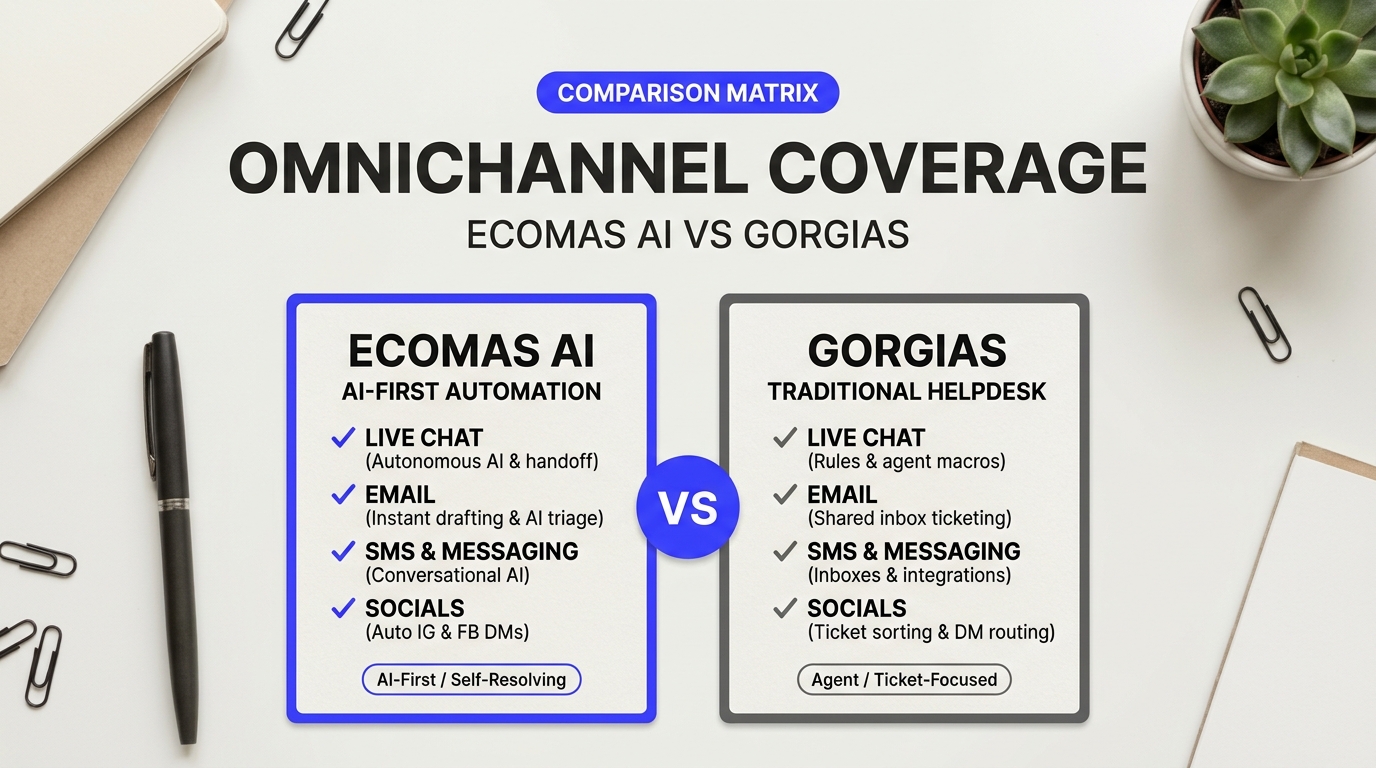
Shoppers rarely take a straight path to your checkout counter. A customer might tap an Instagram ad, drop a question on your post, receive a shipping update via SMS, and then fire off an email asking for an exchange. How your D2C support tool handles these scattered touchpoints decides whether you save a sale or lose a loyal buyer to frustration.
Gorgias and Ecomas AI approach this challenge from opposite ends of the operational spectrum. Gorgias built its reputation by bringing every channel into a single hub designed for human reps. In contrast, Ecomas AI builds autonomous agent layers directly over your communication pipes so inquiries resolve without queuing up for a person.
Omnichannel Architecture: Ecomas AI vs Gorgias Inbox Models
When evaluating ecomas ai vs gorgias across multiple touchpoints, the difference lies in where the work happens. Gorgias acts like an air traffic control tower. It pulls live chat, email, SMS, WhatsApp, and social threads into one unified inbox. Your team sits in that dashboard, viewing full customer histories from Shopify alongside past conversations. It feels organized, reliable, and deeply familiar to any seasoned support lead.
Ecomas AI functions more like an autonomous field worker standing at every door. Instead of routing every message to an agent screen for triage, Ecomas deploys its conversational intelligence natively across live chat widgets, email feeds, and messaging endpoints. It answers questions instantly where the customer stands. It doesn't just collect tickets; it eliminates them before they hit an inbox queue.
| Channel Touchpoint | Gorgias Native Workflow | Ecomas AI Autonomous Model |
|---|---|---|
| Live Chat | Agent-first chat widget with rule-based quick answers and automated flows. | Dynamic conversational agent capable of deep catalog search and autonomous order actions. |
| Email Support | Macro templates, ticket tagging, and AI-suggested draft responses for human review. | Full autonomous reading, drafting, and sending for routine post-purchase inquiries. |
| SMS & Text Messaging | Native Gorgias SMS and deep hooks into Attentive and Klaviyo conversational threads. | API-driven SMS auto-replies focused on order modifications and instant problem resolution. |
| Social Comments & DMs | Direct management of Instagram DMs, Facebook messages, and public ad comments. | Targeted automated responses to direct messages, filtering spam from real buying intent. |
| Unified WhatsApp business inbox managed by support reps alongside tickets. | Autonomous 24/7 conversational flow for international shoppers and instant tracking queries. |
Gorgias clearly holds the upper hand if you rely heavily on public social media management. Running high-spend Meta ad campaigns means you get hundreds of comments every day under your product posts. Gorgias lets you pull those comments right into your helpdesk. You can hide negative spam, auto-reply to positive praise, and convert questions about sizing into closed tickets without leaving the app.
That level of visibility comes with a catch that many fast-growing brands struggle to manage. As noted by marketers discussing omnichannel deployment edge cases, piping every social reaction and spam tag into a ticket-based system can quickly inflate your ticket volume. Because Gorgias bills around billable ticket tiers, simple comments can run up your monthly software invoice if your automation rules aren't tuned perfectly.
"We had thousands of ad comments syncing into Gorgias every weekend. It gave us visibility, but our bill spiked because every greeting was counted as a touchpoint. We had to spend weeks tightening rules just to keep our sanity."
Ecomas AI bypasses that ticket bloat by separating conversation capture from ticket creation. On high-volume surfaces like live chat and WhatsApp, Ecomas AI answers order status questions, processes returns, and recommends matching products directly. If a shopper needs help tracking an order, they don't wait for a human rep to claim a ticket from a queue. The agent connects to your backend data, finds the tracking number, and replies within seconds.
What happens when an issue needs a human touch? You never want a bot trapping an angry customer in an endless loop. Ecomas AI detects frustration or complex warranty claims and hands the customer off to a human agent, passing the full conversation history along. Many stores actually pair an autonomous engine like Ecomas with a platform like Gorgias or Zendesk, letting AI handle the front lines across web and messaging while human reps focus strictly on high-touch escalations.
If your strategy centers on giving human reps a rock-solid, multi-channel cockpit that controls social ad comments, phone calls, and emails, Gorgias is the industry standard. If your goal is to shrink human inbox workload entirely by letting autonomous AI handle live chat, email, and messaging conversations on the spot, Ecomas AI delivers the faster, leaner customer journey.
Integration Ecosystem and Tech Stack Compatibility
Think of software integrations like electrical outlets. If an app doesn't fit your wall socket cleanly, you're stuck buying bulky adapters, rewiring circuits, or dealing with blown fuses. In the D2C world, a support tool cannot live on an island. It has to talk constantly to your storefront, your marketing engine, your subscription manager, and your returns portal.
The philosophical difference between these two platforms becomes crystal clear the moment you look at how they connect to your tech stack. Gorgias acts like a master dashboard built for a human pilot. It pulls customer records from every corner of your business and pins them to a tidy sidebar so your human agents don't have to juggle twenty browser tabs. Ecomas AI treats integrations less like static reference cards and more like autonomous hands. It taps into your apps to run actions on behalf of the shopper without waiting for a rep to click a button.
Plugging into D2C Tech: Ecomas AI vs Gorgias Integration Depth
Store platform support is the baseline requirement. If a tool doesn't sync with your core catalog and order database, nothing else matters.
Gorgias built its empire on Shopify. Its integration with Shopify is arguably the most polished in the entire support software industry. You get instant access to order histories, line-item cancellations, financial adjustments, and live tracking numbers. BigCommerce and Magento integrations are also solid, though WooCommerce setup requires slightly more manual configuration and occasionally runs into webhook delays on busy hosting setups.
Ecomas AI approaches store platforms with an API-first mindset. It connects to Shopify in a couple of clicks, reading catalog schemas, inventory counts, and historical customer behavior instantly. It also supports BigCommerce and WooCommerce through secure webhooks, but its real superpower lies in how fast it indexes dynamic store data. If you change a variant price or update shipping rules in your admin, Ecomas AI updates its conversation logic right away.
When evaluating ecomas ai vs gorgias across modern tech stacks, the way each tool handles third-party apps determines how much manual labor your team actually eliminates.
| Tool & Category | Gorgias Setup | Ecomas AI Setup | Day-to-Day Impact |
|---|---|---|---|
| Recharge Subscriptions |
Displays subscription cards in sidebar. Agents click to pause, skip, or cancel. | AI autonomously verifies the user and executes pause, skip, or frequency changes via chat. | Eliminates repetitive "skip my next charge" tickets entirely from agent queues. |
| Loop Returns Reverse Logistics |
Fetches RMA status and return labels for human reps to paste into replies. | Generates return portals links, checks return eligibility, and answers status queries automatically. | Cuts return-related ticket volume during peak holiday shipping windows. |
| Klaviyo Email & SMS |
Shows campaign engagement, SMS opt-ins, and VIP segment tags in the ticket pane. | Syncs chat interactions, purchase intent, and customer complaints directly into Klaviyo custom events. | Enables automated post-support follow-ups and prevents marketing emails to unhappy buyers. |
| Yotpo Reviews & Loyalty |
Pulls review scores and loyalty point balances into the agent sidebar view. | Reads point balances in real time to recommend reward redemptions during live buying chats. | Turns mundane balance checks into immediate upsell opportunities. |
Store owners often share real frustrations about these integrations. A common sentiment highlighted in user experiences with tech stack compatibility centers on whether an integration actually solves a problem or just makes another screen to look at. Having data on a screen is great. Having an engine that acts on that data is completely different.
"Data visibility helps your staff answer faster. Autonomous action keeps the ticket from ever reaching your staff in the first place."
Consider a standard subscription question: "Can I skip my coffee shipment this Friday?"
In Gorgias, the ticket arrives. The agent sees the customer's Recharge widget on the right side of the screen. The rep clicks "Skip Next Delivery," clicks an email template, and hits send. The whole process takes ninety seconds. That's fast, but it still requires human payroll.
In Ecomas AI, the customer sends that exact sentence into chat. The AI checks the customer's email, matches their Recharge ID, authenticates the request, skips the delivery date via API, and confirms the new schedule in seconds. The human agent never touches it. That's the boundary between a traditional ecosystem and an agentic one.
Gorgias holds the upper hand if you use niche apps or older enterprise platforms. It has had years to build out its app directory, boasting over one hundred pre-built connectors. If you rely on specialized warehouse software or bespoke ERP tools, Gorgias probably has an off-the-shelf hook or HTTP action ready to go. Ecomas AI concentrates its connectors on modern, high-volume D2C tools where speed and full automation matter most.
Pricing Structure and True Cost of Scale: Ticket Tiers vs. AI Automation Fees
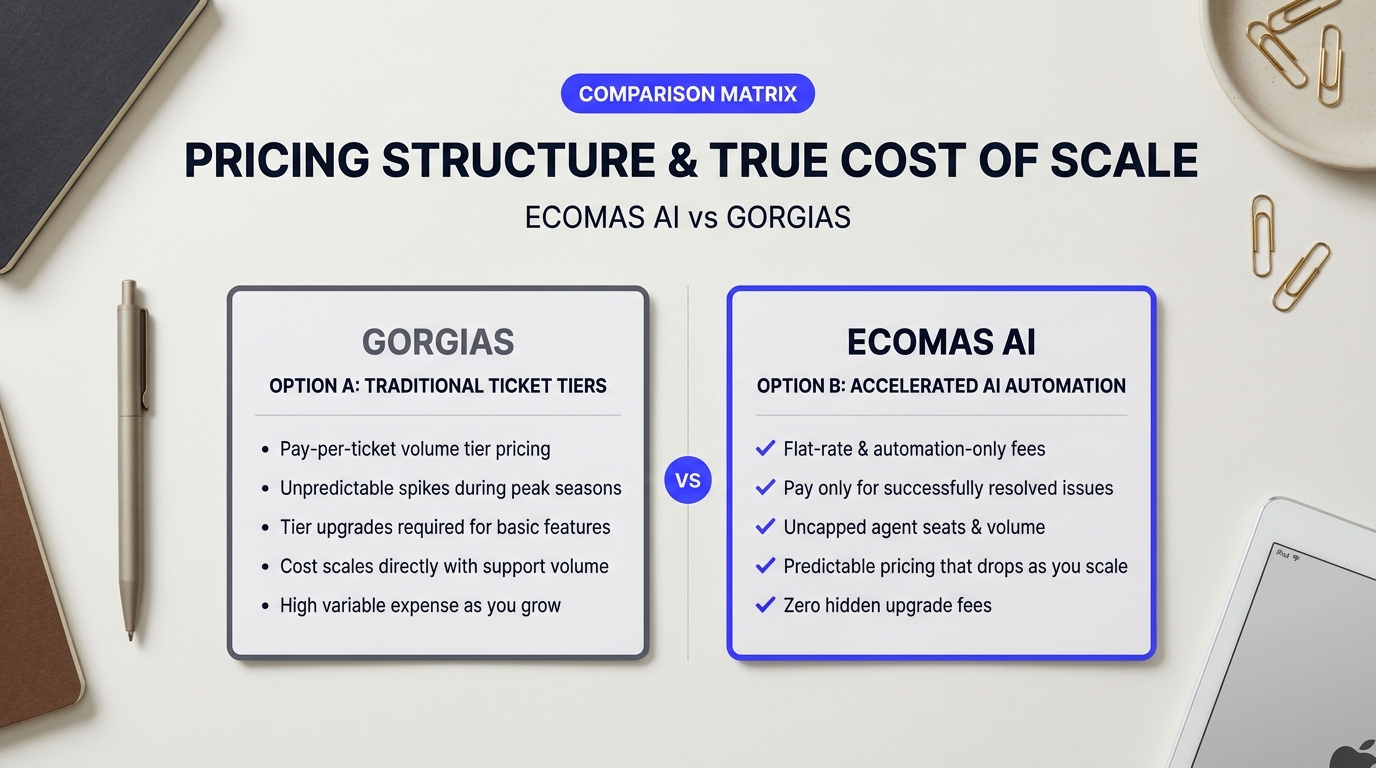
Software bills shouldn't feel like a moving target. When your D2C brand expands, the pricing model behind your customer support tool directly dictates your profit margins. Comparing ecomas ai vs gorgias exposes two fundamentally opposing philosophies: paying for every inbound customer message versus paying for autonomous resolution capacity.
Gorgias built its reputation on a classic helpdesk framework. It charges based on billable tickets. A ticket turns billable the moment an agent sends an email, replies to a chat, or fires an automated macro. If a customer sends three separate inquiries about a delayed shipment across Facebook, email, and chat, those messages can quickly eat up multiple billable tickets unless your team manually merges them in real time.
Deconstructing Support Costs: Ecomas AI vs Gorgias
The traditional ticket-tier model creates an awkward tension. When you succeed in driving traffic and sales, your ticket volume explodes. Gorgias handles this through predefined monthly brackets—such as 300, 2,000, or 5,000 tickets. Blow past your cap, and you trigger automatic overage fees, which usually run between $35 and $50 for each extra bundle of 100 tickets.
Layering automation onto that setup complicates the math. The Gorgias AI Agent does not come free with your standard tier. Instead, it carries an added usage fee—often ranging from $0.75 to $1.00 for every successfully automated resolution. You end up paying for the base helpdesk platform, the tier allowance, and a separate meter for every customer who never even touches a human agent.
This compounding cost is a frequent topic of debate among e-commerce operators. As highlighted by store operators discussing support pricing benchmarks, managing unexpected overage spikes while paying extra for AI automation can make monthly support expenditures wild and unpredictable.
Ecomas AI approaches the ledger from the opposite direction. Because it is engineered from scratch as an autonomous agent rather than a legacy human ticketing desk, its pricing aligns with task completion and capacity. You aren't penalized simply because a customer asks three clarifying questions before buying a sweater. The system absorbs conversational back-and-forth without turning every single reply into a billable line item.
| Pricing Metric | Gorgias | Ecomas AI |
|---|---|---|
| Core Billing Basis | Billable ticket tiers (inbound customer interactions). | Autonomous resolution capacity / predictable scale. |
| AI Add-on Pricing | Consumption-based fee per automated resolution (~$0.75-$1.00 each). | Native AI core included directly in the base architecture. |
| Overage Penalties | Per-hundred ticket penalty blocks when limits are exceeded. | Elastic bandwidth with fixed or tiered bounds. |
| Budget Predictability | Variable. Invoices swing based on chat spikes and spam volume. | High. Flat operational expenditure during high-volume pushes. |
Peak Shopping Surges: Which Architecture Protects Your Margin?
Holiday sales reveal the true cost of customer service software. Consider a medium-sized D2C merchant handling 3,000 monthly tickets from January through October. During Black Friday, Cyber Monday, and the December holiday push, order counts quadruple. Customer support requests surge alongside them to 12,000 tickets in a single month.
What happens to your invoice under a ticket-based system?
"When ticket counts spike 300% during Q4, helpdesk bills shouldn't swallow your gross margin. If you pay an entry tier, pay overage fines, and then pay an extra dollar for every AI deflection, you're getting taxed three times on the same customer."
On Gorgias, you face two choices. You can manually upgrade to an expensive enterprise bracket before the surge starts, hoping you estimated the volume accurately. Or you can stay on your current tier and pay punitive overage blocks on 9,000 extra tickets. If your AI resolves 60% of those inquiries (5,400 tickets), you could see thousands of dollars in AI automation fees tacked onto your standard software bill.
Competing tools like Zendesk or Freshdesk charge per human seat, but Gorgias hits you on ticket volume, making surges expensive. In an ecomas ai vs gorgias evaluation during peak season, Ecomas AI shields your margins. Since the platform operates as an end-to-end autonomous resolution engine, holiday spikes are absorbed without double-dipping fees. The system simply executes the workflows, handles returns, answers WISMO ("Where is my order?") inquiries, and manages order updates without charging extra for every customer message.
For brands with stable, low-volume communication, Gorgias's ticket tiers remain simple to follow. For high-growth stores experiencing sharp seasonal peaks, paying per ticket and per AI deflection turns customer communication into an unpredictable tax. Ecomas AI decouples your support bill from raw message counts, giving growing stores a much clearer path to positive ROI.
Onboarding Friction and Setup: Time-to-Value for E-Commerce Teams
Setting up customer service software used to mean weeks of manual labor. You had to map out ticket routing, write hundreds of canned responses, and train human reps on keyboard shortcuts. That legacy model defines the standard ticketing workflow. Autonomous AI flips that model on its head. When looking at ecomas ai vs gorgias, the onboarding paths reflect two completely different philosophies of how a D2C support tool should work.
Implementation Reality: Ecomas AI vs Gorgias Setup Speed
Getting Gorgias live feels like building a mini call center inside your browser. First, you connect your Shopify or BigCommerce store and redirect your support inboxes. That part takes twenty minutes. The heavy lifting comes right after.
You have to build macro templates from scratch. You must configure multi-condition rules: if an order status is unfulfilled and customer sentiment is negative, tag the ticket and route it to tier-two support. It is like programming with digital building blocks. Miss one tag, and the whole flow fails. For growing stores that evaluate traditional options like Zendesk alongside Gorgias, a typical team spends two to four weeks writing macros, calibrating rules, and testing inbox views before reps feel confident handling live volume.
Ecomas AI takes an autonomous approach. Instead of training people to push buttons, you train an engine to understand your catalog. You plug in your store, connect your policy pages, and upload your knowledge base documents. The platform ingests shipping guidelines, return portals, and sizing charts directly.
Prompt engineering replaces macro construction. You don't build fifty branching rules for lost packages. You write clear operating instructions: if a package hasn't scanned in seven days, verify the shipping address, apologize, and offer a replacement if the order is under $100. The agent reads the context and executes the action. Setup shrinks from weeks to a few afternoons.
Support managers often get caught off guard by maintenance overhead. A common sentiment raised in Reddit SaaS rollout discussions points out that teams frequently underestimate how much ongoing labor traditional rule engines require when manual workflows crack under new promotions. Static macros rot quickly when return policies change during peak holiday seasons.
| Setup Component | Gorgias | Ecomas AI |
|---|---|---|
| Initial Integration | One-click store and inbox sync (1 hour) | One-click store and inbox sync (1 hour) |
| Content Ingestion | Manual copy-pasting into macros and help center | Automated ingestion of URLs, FAQs, and policies |
| Response Logic | IF/THEN rules, regex tags, and manual macros | System prompts, guardrails, and dynamic API lookups |
| Staff Training | High; reps must learn UI, hotkeys, and macro libraries | Low; human agents only manage complex escalations |
| Time-to-Value | 14 to 30 days to reach peak workflow efficiency | 2 to 5 days to reach autonomous handling |
Knowledge Base Ingestion and Guardrail Calibration
A knowledge base is only as good as the software's ability to retrieve the right sentence at the right second. In Gorgias, the knowledge base lives primarily as an external help center for shoppers or an internal reference cheat sheet for agents. If you want the system to answer questions through automated rules, you have to map specific help center articles to pre-selected customer intents. You manually tell the system which article solves which question.
Ecomas AI uses semantic retrieval to pull answers dynamically. Think of it like giving an assistant a search engine across your entire brand history. It indexes your return portal (like Loop or Returnly), your shipping terms, and even product catalog updates. You don't have to map out every permutation of a question.
Calibration requires setting firm boundaries. You define exact spending caps for refunds, strict conditions for order cancellations, and clear criteria for human handoffs. Once those boundaries are set, the platform starts resolving tickets without requiring an agent to click a macro. For direct-to-consumer operators debating between ecomas ai vs gorgias, the setup difference boils down to this: Gorgias builds a faster cockpit for your human team, while Ecomas AI deploys an autopilot that flies the plane for them.
Which Customer Support Platform Best Fits Your Store?
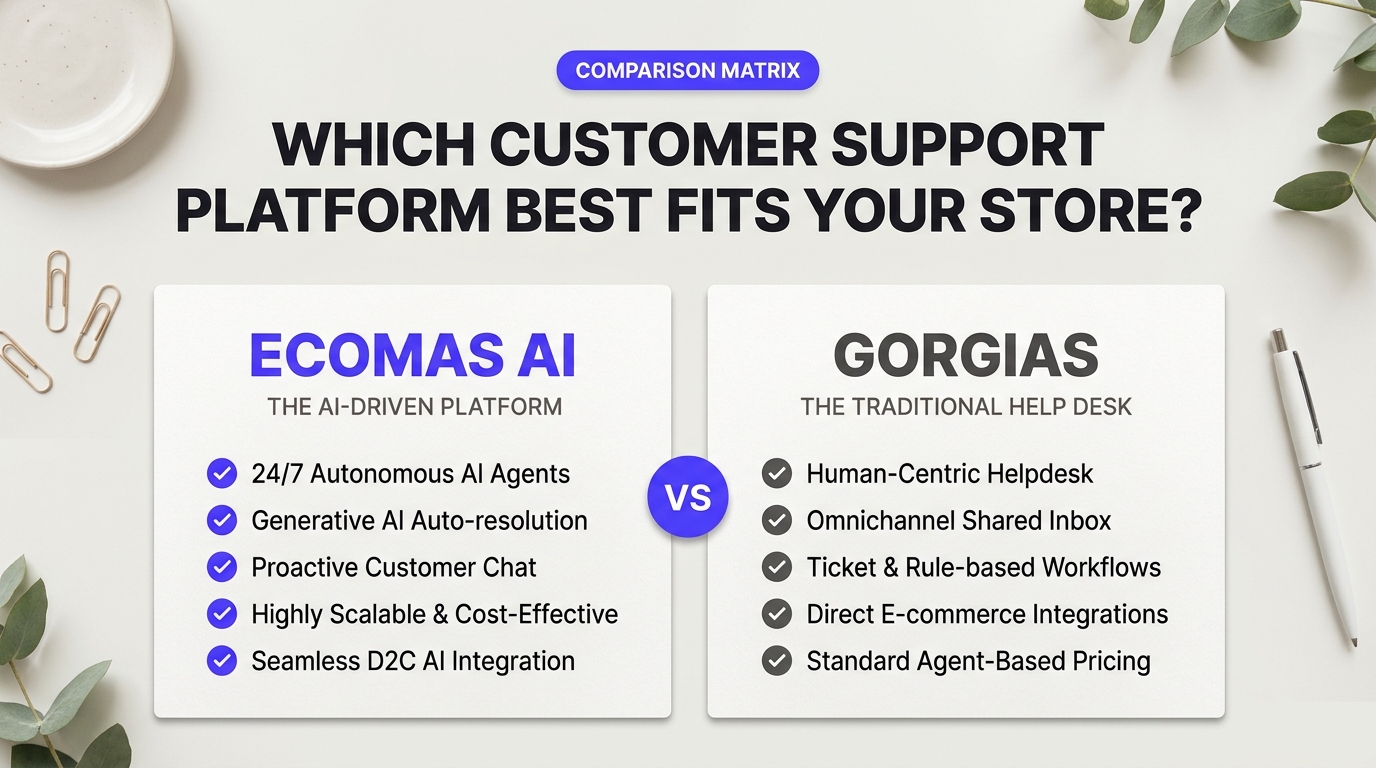
Your choice comes down to your operating philosophy. Do you want a command center for human agents, or do you want software that eliminates tickets before a human ever touches them? Support software isn't one-size-fits-all. Buying the wrong tool leads to frustrated shoppers, bloated payroll, and expensive software bills that sting at the end of every quarter.
Evaluating Ecomas AI vs Gorgias for Your Store Scale
Choosing between ecomas ai vs gorgias comes down to who you want handling the ticket. Think of Gorgias like an ultra-modern control cockpit for a pilot. Your support agents sit in the pilot seat. The software hands them macros, pulls customer data from Shopify, and lets them reply rapidly across email, chat, and Instagram comments. In contrast, Ecomas AI acts like self-driving autopilot. It reads the customer intent, logs into your commerce backend, executes the action, and closes the ticket without human intervention.
| Decision Factor | Gorgias | Ecomas AI |
|---|---|---|
| Ideal Team Size | Dedicated internal teams or BPO agencies (3+ agents) | Lean teams, solo founders, or 1-2 person support desks |
| Primary Work Style | Agent-assisted triage, macro shortcuts, manual reviews | Fully autonomous end-to-end task execution |
| Social Channel Priority | Heavy focus on Instagram ad comments and TikTok DMs | Heavy focus on transactional email and live store chat |
| Action Autonomy | AI drafts responses; agents approve or set static rules | Direct actions taken in Shopify, ERPs, and carriers |
| Cost Driver | Total ticket volume tiers plus add-on AI fees | Resolution-based pricing without agent seat penalties |
Community feedback highlights how differently these models perform in practice. As seen in threads from Reddit e-commerce operators debating support alternatives, brands often hit unexpected friction when using traditional helpdesks for routine tracking requests. Paying a per-ticket fee simply to tell a shopper their package is in transit destroys profit margins quickly.
When Gorgias Is the Clear Winner
Gorgias remains the gold standard for established direct-to-consumer operations that maintain an active support roster. If your customer experience relies on human warmth, bespoke styling advice, or high-touch VIP assistance, you need a robust agent workspace. Legacy platforms like Zendesk were built for generic IT desks, but Gorgias was tailored specifically for e-commerce workflows.
You should pick Gorgias if your brand matches these conditions:
- You manage high-volume social ad campaigns: Your marketing team spends tens of thousands each month on Meta and TikTok ads. Gorgias captures public comments on your paid ads so reps can turn pre-sale questions into immediate sales.
- You already employ dedicated support reps: You have full-time staff or an outsourced support agency. Your priority is tracking their response times, setting collision detection, and auditing individual agent productivity.
- Your catalog demands high-touch consultations: You sell custom jewelry, luxury furniture, or medical cosmetics. These shoppers need nuanced, consultative guidance that an AI model shouldn't handle alone.
When Ecomas AI Is the Smarter Investment
If you run a lean e-commerce brand doing 2,000 to 20,000 orders a month, you likely don't want to manage a human call center. You want repetitive questions solved instantly. When a customer emails asking to cancel an order placed ten minutes ago, an autonomous agent can modify Shopify directly instead of pinging a rep.
Choose Ecomas AI if you recognize your business in these points:
- Your inbox is flooded with repetitive transactional tickets: Up to 70% of your incoming volume consists of order status checks, simple address updates, returns, and tracking queries. Ecomas AI completes these backend tasks autonomously without human triage.
- You want to avoid hiring extra headcount: You want your current staff focused on product development, influencer marketing, or inventory management rather than replying to basic shipping questions all weekend.
- You dislike ticket overage traps: Many helpdesks penalize fast growth by charging steep fees when promotional emails spark a temporary surge in inbound tickets. Ecomas AI aligns costs with true autonomous resolutions rather than raw ticket counts.
"We realized we didn't need faster canned responses. We needed a system that actually executed cancellations and address corrections in our warehouse system while our team was asleep."
For brands stuck in the middle, evaluating your ticket profile offers immediate clarity. Check your last 500 tickets. If most queries require nuanced human negotiations, Gorgias provides the deep tooling your team requires. If most inquiries are basic transactional chores that pull data straight from your storefront, deploying a dedicated system like Ecomas AI saves both time and payroll.
The Strategic Verdict: Future-Proofing Your E-Commerce Customer Experience
Support shouldn't bleed your margins. As retail margins tighten, the traditional playbook of throwing more junior agents at growing ticket queues is broken. Store founders face a stark operational choice: empower a human team with centralized workflow tools, or hand over repetitive support tasks entirely to autonomous software.
Making the Call: Ecomas AI vs Gorgias for Modern D2C Operations
Deciding between ecomas ai vs gorgias boils down to how much operational control you want to hand over to machines. Gorgias built the benchmark for human collaboration in e-commerce. It brings your Shopify orders, email threads, SMS messages, and social comments into a clean shared inbox. If your D2C brand relies heavily on high-touch styling advice, VIP concierge service, or custom phone escalation, Gorgias keeps your team synchronized. Its machine-learning features suggest quick answers, but human agents stay firmly in the driver's seat.
Autonomous systems flip that model upside down. Ecomas AI treats customer care as an engineering task rather than a ticket sorting exercise. It doesn't just draft replies for an agent to review during office hours; it connects directly to your store back-end to look up tracking details, modify shipping addresses, and process refunds around the clock. That difference shows up immediately on your balance sheet. As store owners debating support desk alternatives on Reddit often point out, the real threat with legacy desks isn't missing features—it's ballooning per-ticket fees whenever seasonal order volumes surge.
Other industry options like Richpanel and Zendesk offer deep ticketing workflows, but they still require heavy manual configuration to achieve meaningful resolution rates without human oversight. When seventy percent of your support inbound consists of predictable order tracking queries and basic exchange requests, paying humans to paste canned templates wastes precious capital.
Take an honest look at your ticket distribution before signing a long contract. Stick with Gorgias if you have a dedicated support staff, run proactive social sales campaigns, and need a reliable home base for team collaboration. Turn to Ecomas AI if your primary goal is slashing ticket overhead, resolving repetitive logistics questions instantly, and keeping headcounts flat as your order volume doubles.