Ecomas AI vs AdCreative.ai for E-Commerce - ecomas ai vs adcreative ai
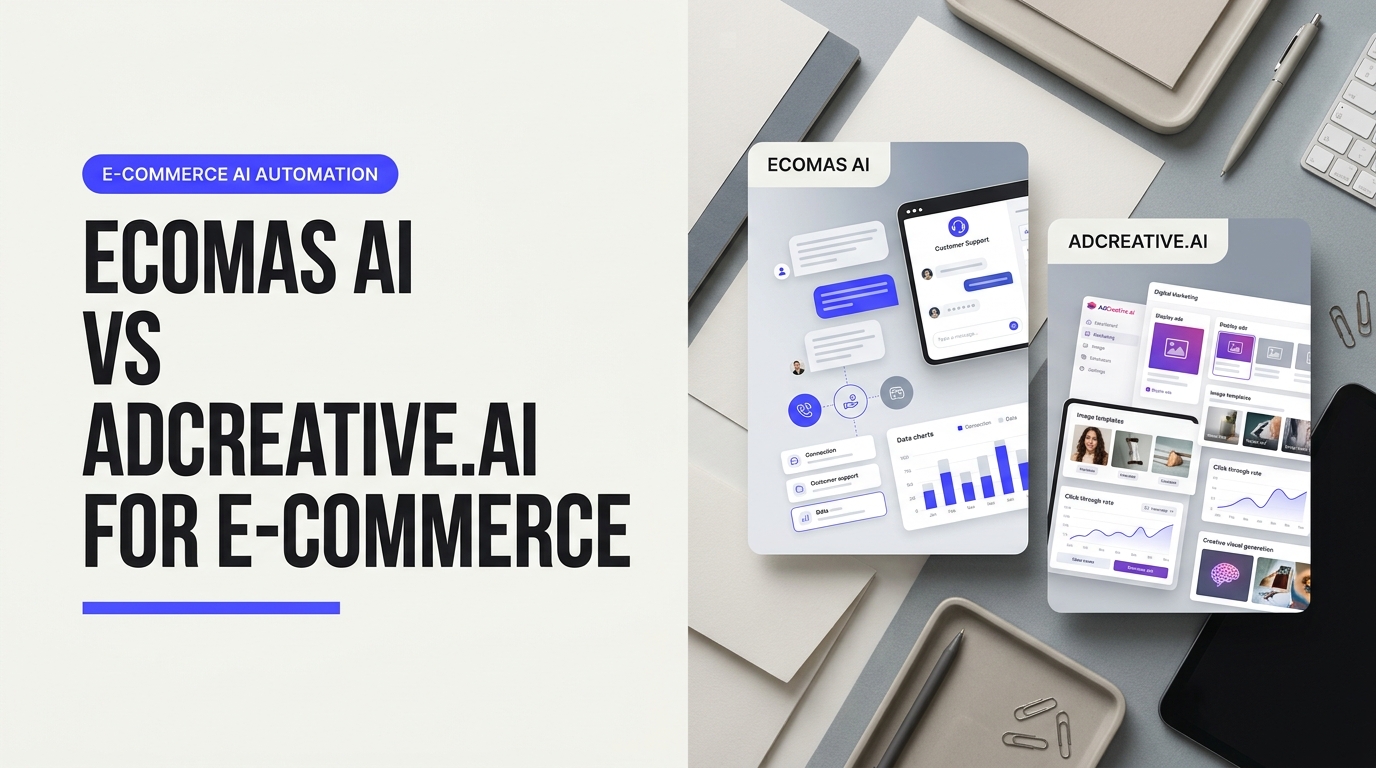
Running an online retail store feels like fighting a two-front war. On one side, you need scroll-stopping visuals to keep customer acquisition costs from devouring your margins. On the other, manual back-end workflows and inventory updates swallow hours of productive work every day. Comparing ecomas ai vs adcreative ai highlights this fundamental split in modern e-commerce automation. Both tools target major bottlenecks, but they operate on completely different ends of your business engine.
Table of Contents
- Modern Retail Automation: Creative Generation vs. Operational Intelligence
- Core Operational Differences and Distinct Focus Areas
- High-Volume Asset Generation: How AdCreative AI Solves Ad Fatigue
- Storefront Operations and Support: What Ecomas AI Solves
- Usability and Integration: Plug-and-Play vs. Embedded Systems
- Cost Structures and ROI: Creative Velocity vs. Operational Savings
- Which Solution Fits Your Business? Decision Framework
- Building a Cohesive Automation Stack for Retail Growth
Think of your digital storefront like a busy downtown boutique. Visual generation platforms handle the window displays, exterior banners, and sales flyers that pull shoppers off the sidewalk. Operational intelligence platforms run the back room, track shipments, audit inventory counts, and organize customer data so orders ship without delay. One draws traffic; the other keeps the store running smoothly when that traffic arrives.
Paid ad channels like Meta, TikTok, and Google Performance Max consume media faster than ever. Ad fatigue sets in within days. Creative production teams struggle to pump out dozens of fresh variations each week, leading directly to rising ad costs and burnt-out designers. Specialized creative generation systems fix this front-end pressure by using trained machine learning models to assemble conversion-focused banners, product mockups, and text hooks in seconds.
Traffic alone won't protect your profit margins. If a merchant pours money into winning ads while their catalog contains broken variants, stockouts, or slow fulfillment cycles, customer lifetime value drops sharply. Operational intelligence platforms focus inward. They monitor catalog health, coordinate order handling, spot fulfillment leaks, and help small teams run complex stores without hiring a small army of operators.
Growing brands frequently stumble into this trade-off. As experienced merchants pointed out in a Reddit community thread on e-commerce automation benchmarks, small teams often waste budget scaling their ad creative production when their actual barrier to growth is backend fulfillment speed and stock sync errors. When evaluating ecomas ai vs adcreative ai, the central question isn't about which tool has flashier technology. It comes down to identifying whether your current growth bottleneck sits in front-end creative fatigue or back-office operational strain.
Ecomas AI vs AdCreative AI: Core Operational Differences and Distinct Focus Areas
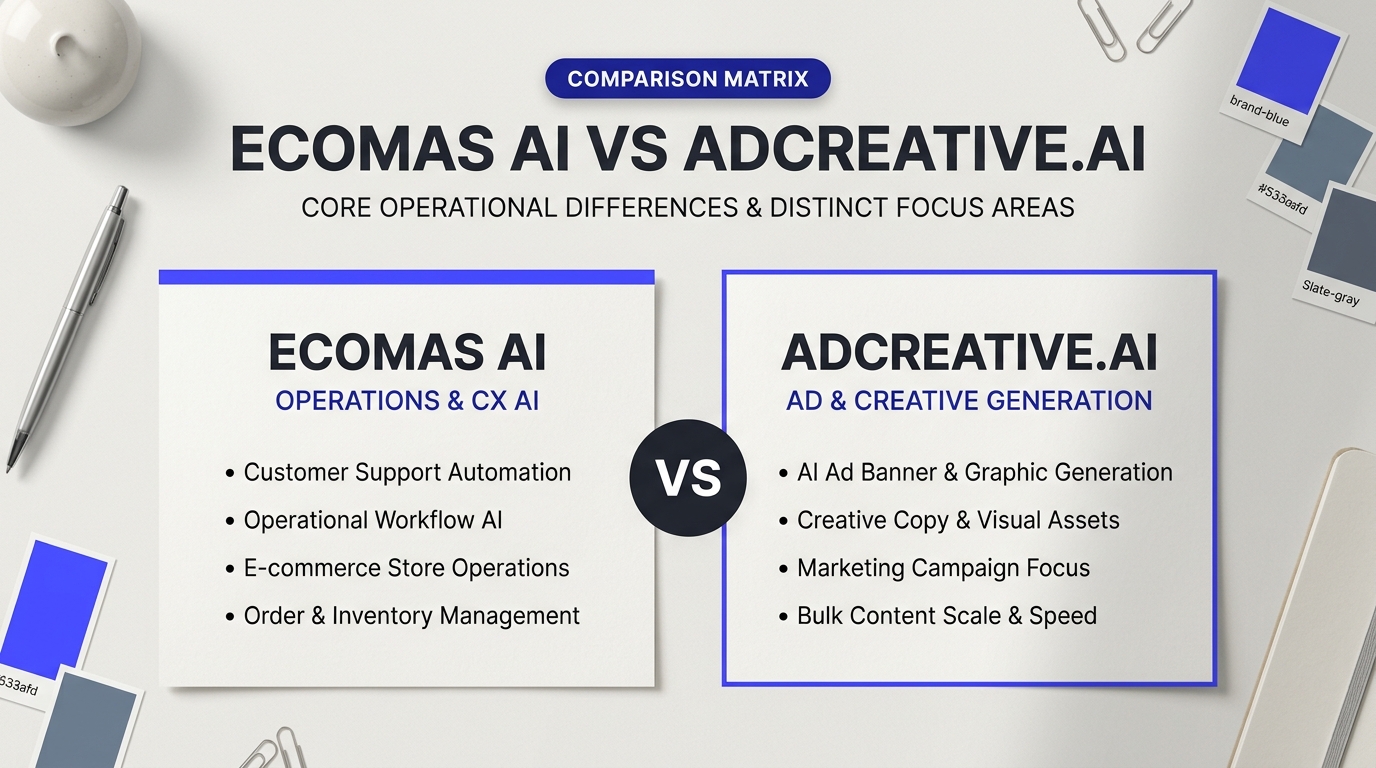
Online retail runs on two separate engines: customer acquisition and back-office execution. If either engine sputters, profit margins vanish. When evaluating ecomas ai vs adcreative ai, the first step is knowing where your team loses the most hours. These two platforms don't compete for the same tasks on your daily to-do list. They solve entirely different headaches across your business model.
AdCreative AI lives in the fast-paced world of paid acquisition. It functions like a tireless design agency working around the clock. You give it your product imagery, brand colors, and target audience details. In return, its machine learning models assemble hundreds of high-converting display ads, banner sets, and marketing copy variations in seconds. It scores each layout based on historic performance data from millions of successful ad runs, helping brands fight ad fatigue without hiring more freelance graphic designers.
Ecomas AI works downstream in the retail trenches. Instead of chasing clicks, it targets merchant efficiency, storefront logistics, and internal support systems. Store owners often find that generating traffic is only half the battle; handling post-purchase inquiries, managing catalog updates, and triaging customer issues eat away their operating margin. Ecomas AI plugs directly into your operational stack to automate store tasks, streamline merchant communications, and keep your business running smoothly behind the checkout counter.
Unpacking the Architecture of Ecomas AI vs AdCreative AI
The technical engines behind both platforms highlight their contrasting priorities. AdCreative AI is built around computer vision, algorithmic graphic layout generation, and predictive conversion modeling. Its neural networks have been trained on high-performing Meta, Google, and TikTok ad assets. The platform understands where to position a call-to-action button, how large product shots should appear, and which typography pairings drive high click-through rates.
Ecomas AI relies on conversational processing, operational routing, and workflow orchestration. Its core design links into product databases, ticketing systems, and inventory trackers. Instead of analyzing click data, it interprets merchant questions, parses shipping inquiries, and automates responses to order changes. It acts less like a creative director and more like an automated operations manager.
| Operational Dimension | AdCreative AI | Ecomas AI |
|---|---|---|
| Primary Function | Generates conversion-focused ad banners and sales copy | Automates store operations, support, and merchant workflows |
| Core Technology | Visual layout neural networks and conversion scoring models | Workflow logic, catalog processing, and customer communication bots |
| Primary End-User | Media buyers, growth marketers, and creative directors | E-commerce founders, store managers, and support teams |
| Main Success Metric | Click-Through Rate (CTR) and Return on Ad Spend (ROAS) | Reduced ticket resolution time and hours saved per order |
Merchant debates often highlight this divide. In a discussion among e-commerce store owners discussing asset rendering speed and operational consistency, users noted that tool selection comes down to where their current pipeline breaks. If your customer acquisition cost is climbing because your creative testing has slowed down, an ad engine is your missing piece. If orders are pouring in but your support inbox is exploding and fulfillment delays are sparking bad reviews, backend workflow automation takes priority.
"Tools that drive traffic won't fix a leaky operational boat. You can generate a thousand sales with smart creatives, but if your back-office systems can't keep up, you end up burning profits on customer refunds."
AdCreative AI produces assets meant for public consumption. Everything it touches faces outward toward prospects who have never heard of your store. It tests color balances, short-form copy, and layout hierarchies to hook passing scrollers on Facebook or Instagram.
Ecomas AI works on the gears inside the machine. It touches processes your shoppers never see directly, such as inventory alerts, support ticket categorization, and post-purchase follow-ups. Choosing between them isn't about deciding which platform has better code. It's about deciding whether your business needs more front-door sales volume or stronger back-door operational stability.
High-Volume Asset Generation: How AdCreative AI Solves Ad Fatigue and Scale
Ad fatigue happens fast. When shoppers see the same sponsored image three or four times, they tune it out completely. Your click-through rates tank. Your customer acquisition costs spike overnight. For retail brands running paid campaigns, keeping pace with asset demand feels like feeding an insatiable furnace. Traditional design workflows in Figma or Photoshop simply cannot produce thirty bespoke variations every week without ballooning payroll.
AdCreative AI tackles this specific bottleneck through algorithmic production. You upload your product transparents, define your hex colors, set your typography, and the platform generates dozens of high-contrast display banners in seconds. It renders these visuals across three core aspect ratios at once: square (1:1) for standard social feeds, vertical (9:16) for Reels and TikTok, and landscape (1.91:1) for Google Display networks. You spend less time resizing canvas borders and more time monitoring spend.
Predictive Conversion Scoring and Direct Network Push
Generating high volume means very little if the creative falls flat. AdCreative AI addresses this by running every generated layout through a machine-learning model trained on millions of historical ad impressions. The platform assigns each layout an automated conversion score out of 100, estimating how well the visual hierarchy, call-to-action button, and headline contrast will capture user attention. Think of it as a quick automated safety check before committing real media budget.
"The true value isn't just making fifty graphics in two minutes; it's spotting which layout configurations prevent audience drop-off before your budget burns out."
Once you select your top-scoring assets, you don't need to manually export folders or re-upload files across multiple browser tabs. Direct API connections link your workspace to Meta Ads Manager, Google Ads, and Pinterest. You can publish selected batches directly into your active campaign ad sets, shaving hours off weekly campaign setup routines.
Ecomas AI vs AdCreative AI: Front-End Velocity Against Store Architecture
When weighing ecomas ai vs adcreative ai, you have to look at where your business loses momentum. Retail teams frequently debate whether automated graphics hold up against custom studio work. In a Reddit discussion on creative rendering speed and consistency, operators pointed out that while algorithmic tools won't replace hero lifestyle photography, they drastically cut the cost of daily promotional testing and seasonal sales banners.
The operational split between ecomas ai vs adcreative ai comes down to acquisition versus back-office stability. AdCreative AI focuses strictly on the top of your sales funnel. It exists to drive clicks, test angles, and keep ad networks supplied with fresh graphics. It doesn't handle inventory synchronization, fulfillment logic, or merchant catalog health. For brands whose paid traffic has stalled due to creative exhaustion, AdCreative AI offers an automated engine built to keep media channels active and running.
Storefront Operations and Support: What Ecomas AI Solves for Online Merchants
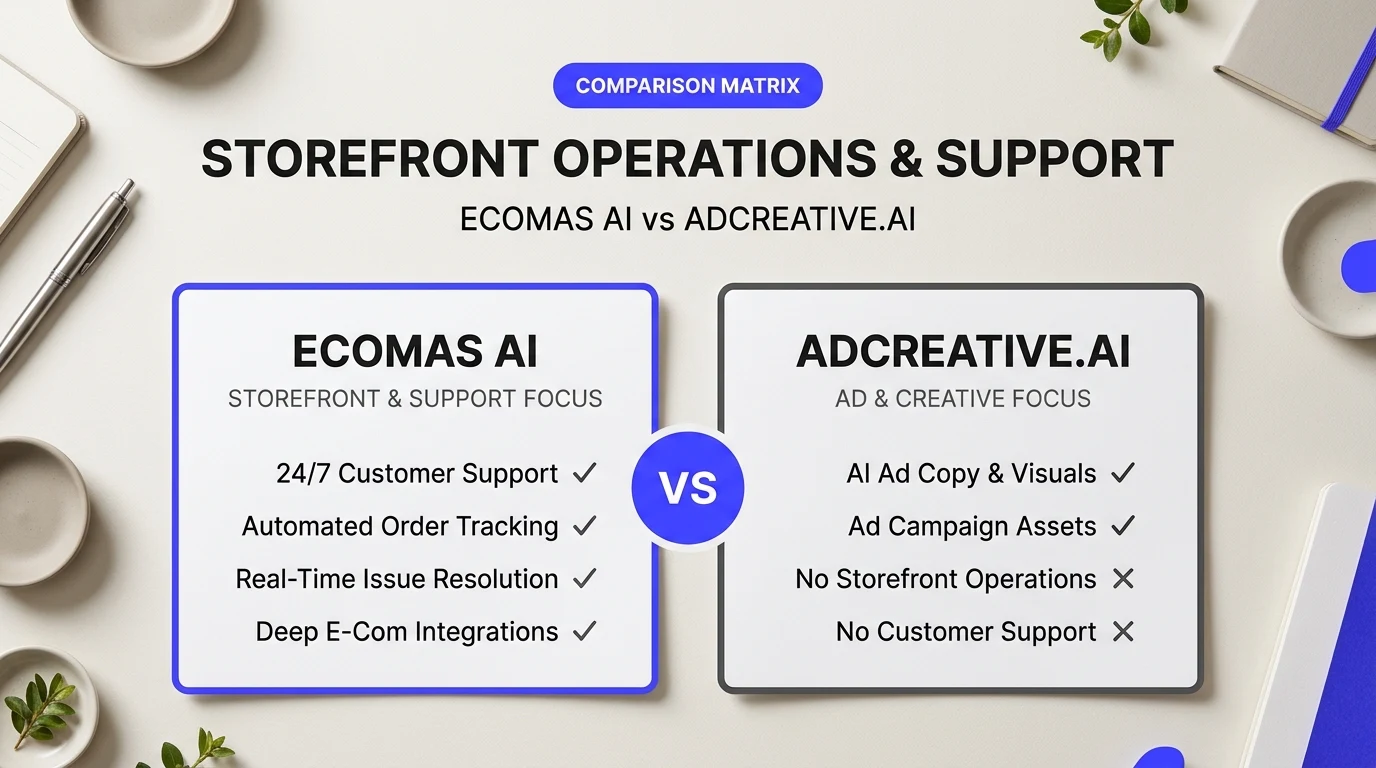
Great marketing gets buyers to your storefront. What happens after they arrive determines whether your business actually makes money. If an ad drives hundreds of eager shoppers to a page where variant descriptions are broken, stock levels don't match warehouse counts, or support queries sit unanswered for six hours, your ad spend evaporates. Ecomas AI tackles this operational breakdown, working quietly behind the scenes to keep the storefront engine running without constant manual babysitting.
Ecomas AI vs AdCreative AI: Post-Click Execution Versus Top-of-Funnel Hype
Most retail automation tools obsess over the first five seconds of customer attention. When comparing ecomas ai vs adcreative ai, merchants quickly discover that they solve problems on opposite sides of the transaction ledger. AdCreative AI lives before the click, churning out display banners, social variations, and high-energy ad copy. Ecomas AI takes over once that visitor lands on your actual store.
Think of it like running a busy brick-and-mortar boutique. AdCreative AI hands out eye-catching flyers on the street corner. Ecomas AI organizes the inventory shelves, prices the items correctly, and answers questions at the cash register. Without strong floor management, those flyers simply create a chaotic store that frustrates shoppers. As retail founders discussing storefront operational benchmarks on Reddit frequently note, scaling ad spend without backend stability only amplifies operational errors and inflates refund rates.
"Generating thirty ad variations in an hour sounds amazing until your customer service inbox drowns because catalog data is missing specs and sizing advice."
Automating Catalog Synchronization and Buyer Support
Online store catalogs change constantly. Price adjustments, new supplier bundles, seasonal tags, and stock counts shift throughout the day. Manually updating hundreds of SKUs across multiple sales channels is slow and error-prone. One wrong number in your system can trigger dozens of cancellations and angry customer chargebacks.
Ecomas AI acts as an operational traffic controller for your product library:
- Unified Catalog Syncing: It updates product attributes, tags, and availability dynamically across your storefront. If a vendor changes ingredient specs or sizing metrics, the system pushes updates to product pages immediately.
- Context-Aware Buyer Assistance: Traditional chat boxes rely on rigid decision trees that infuriate shoppers. Ecomas AI taps directly into your active product feeds to answer specific buyer questions about measurements, compatibility, and delivery timelines in plain English.
- Order Routing and Ticket Relief: Common post-purchase inquiries—like tracking lookups or address fixes—get resolved instantly without an employee manually opening your dashboard.
Instead of stitching together disconnected helpdesk tools like Gorgias alongside messy third-party webhook automations, Ecomas AI keeps catalog changes and customer conversations connected inside the same pipeline. Your team stops wasting hours answering "where is my tracking number?" and focuses on product development.
Operational Efficiency vs Creative Production
Choosing where to invest your automation budget depends on where your business feels the most pain. Here is how operational automation stands apart from asset generation:
| Operational Function | AdCreative AI Focus | Ecomas AI Focus |
|---|---|---|
| Primary Goal | Lowering cost-per-click and beating ad fatigue | Preserving margins and speeding up order resolution |
| Data Source | Ad performance history and audience demographics | Live SKU inventories, order histories, and support logs |
| Daily Time Savings | Cuts down Photoshop design and copywriting hours | Eliminates manual catalog updates and routine customer tickets |
| Bottom-Line Metric | Return on Ad Spend (ROAS) | Customer Lifetime Value (LTV) and operational overhead |
Evaluating Setup Time and Real Merchant ROI
Is an operational platform worth the monthly software cost for a small or mid-sized brand? That depends entirely on your daily order volume. If you sell five custom items a week, you don't need automated storefront synchronizations. You can handle questions and inventory updates in a spreadsheet.
Once your catalog crosses fifty active products and order volume hits dozens of daily shipments, manual workflows break down fast. A merchant spending twenty hours every week copying tracking codes, updating out-of-stock tags, and answering basic emails is losing money. That lost time pulls attention away from sourcing and brand building.
Setup for storefront automation generally takes an afternoon of mapping your store collections and configuring brand response parameters. You don't have to hire a developer to write custom API scripts. The platform reads your catalog structure and begins handling common customer friction points on day one. By resolving questions right when a buyer hesitates at checkout, the software recovers sales that would have otherwise vanished into an abandoned cart.
Usability and Tech Stack Integration: Plug-and-Play Tools vs. Embedded Automation
Choosing between external generation and embedded store automation comes down to where you want software to live in your retail stack. Some platforms run entirely outside your store, acting as fast asset factories. Others hook straight into your catalog and order databases to run behind-the-scenes tasks. When evaluating ecomas ai vs adcreative ai, the distinction boils down to where the software lives in your ecosystem and who on your team has to manage it day to day.
AdCreative.ai functions like an external graphic production house. You plug your brand colors, logos, and ad accounts into its cloud dashboard, and it spits out ready-to-test banners and copy variations. Ecomas AI takes the opposite path. It embeds directly inside your e-commerce platform—such as Shopify or WooCommerce—to assist storefront workflows, automate operational tasks, and synchronize customer or catalog data. One tool powers your acquisition funnel, while the other optimizes your back-office execution.
Comparing Workflows: Ecomas AI vs AdCreative AI in Daily Practice
The operational divide between these platforms shows up immediately during onboarding. To see how they fit into standard team routines, consider how each system connects to your day-to-day tools.
| Operational Dimension | AdCreative.ai (Plug-and-Play) | Ecomas AI (Embedded Automation) |
|---|---|---|
| Primary Touchpoint | Standalone web dashboard | Storefront admin (Shopify / WooCommerce) |
| Time to First Value | Under 15 minutes | 2 to 5 hours (requires data mapping) |
| Key Integrations | Meta Ads, Google Ads, TikTok, Pinterest | Product catalogs, order pipelines, support desks |
| Technical Skill Needed | None (No-code visual interface) | Moderate (Store logic and trigger setups) |
| Daily Operator | Media buyer or content marketer | E-commerce manager or operations lead |
AdCreative.ai requires almost zero technical setup. You create a workspace, input your brand guidelines once, and link your ad accounts through standard OAuth logins. From there, generating an ad set takes just a few clicks. You upload a transparent product render, type a target audience prompt, pick an aspect ratio, and the AI renders dozens of visual variations scored by predicted conversion rates. If an asset looks right, you push it directly to your Meta Ads Manager campaign. If it doesn't, you tweak the headline inside the built-in visual editor and re-render.
Ecomas AI demands a deeper footprint. Because it operates within your operational store engine, setup involves connecting private apps, granting inventory permissions, and aligning product tags. If your Shopify store maintains thousands of custom SKUs, variant metafields, or multi-currency pricing, Ecomas AI must ingest those rules correctly before running automated workflows. It handles store logic rather than visual marketing assets, making the initial configuration much more critical.
Ecosystem Connectivity: Ad Networks vs. Store Engines
The value of any retail automation depends on the tools it talks to. When software doesn't sync cleanly with your existing stack, your staff ends up doing tedious copy-paste work.
AdCreative.ai focuses its pipeline outward toward paid media channels. It maintains direct API connections with major ad platforms:
- Meta Ads Manager: Pushes rendered static ads and short video clips directly into ad sets as draft or active creatives.
- Google Ads: Generates responsive display assets and paired headlines that match Google's format guidelines.
- Social Channels: Formats outputs for TikTok, Pinterest, and LinkedIn without requiring manual cropping or resizing.
It doesn't alter your website, touch your checkout, or interact with customer accounts. If you want to pull live products from your catalog into AdCreative.ai, you typically import a static product feed or upload individual image URLs. It treats your store as a source of images, not as an active operational environment.
Ecomas AI connects inward to your core e-commerce engine. It talks directly to your Shopify Admin API or WooCommerce REST endpoints. Rather than pushing files to advertising dashboards, it syncs with:
- Inventory and Product Feeds: Watches SKU levels, updates status tags, and helps manage catalog attributes across collections.
- Customer Interaction Data: Feeds operational context—like delivery status, backorders, and policy details—into storefront communication paths.
- Third-Party Store Apps: Coordinates with fulfillment plug-ins and customer service platforms to reduce manual updates.
"The biggest friction point in store automation isn't the AI's speed; it's whether the tool breaks your existing data logic when your catalog scales past 500 items."
That observation, drawn from merchants in this Reddit r/ecommerce automation discussion, points directly to the real trade-off. An external tool like AdCreative.ai can never corrupt your live store data. If it generates a poor ad, your worst-case scenario is a rejected campaign asset. An embedded automation tool, by contrast, touches live operational data. It provides higher leverage, but it demands cleaner setup and ongoing governance.
Team Bandwidth and Technical Expertise Required
How much employee time will these systems eat up every week? Your team profile should guide your decision.
Running AdCreative.ai: A junior media buyer or solo brand owner can master the platform in an afternoon. You don't need a designer or a front-end developer. The primary time investment occurs in short sprints: spending an hour on Monday generating 30 visual variants for upcoming paid testing cycles. Because the software handles layout, color palettes, and typographic hierarchy automatically, it eliminates back-and-forth design revisions. However, human eyes are still needed to filter out awkward AI copy choices or misaligned brand logos before spending real ad dollars.
Running Ecomas AI: This platform is suited for technical founders, dedicated e-commerce managers, or operations specialists. You must understand how your store triggers events, how webhook payloads behave, and where customer data flows between apps. While it ultimately saves dozens of hours in manual inventory updates and store task handling, it requires dedicated oversight during the first month. If your team lacks someone comfortable navigating store backend settings and data field mapping, deployment will feel sluggish.
If your primary bottleneck is creative fatigue and slow ad iteration, AdCreative.ai drops into your stack without disturbing your technical setup. If your marketing is already profitable but your team is drowning in repetitive storefront management and backend upkeep, investing the time to integrate Ecomas AI delivers the deeper operational relief.
Cost Structures and ROI: Evaluating Creative Velocity Against Operational Savings
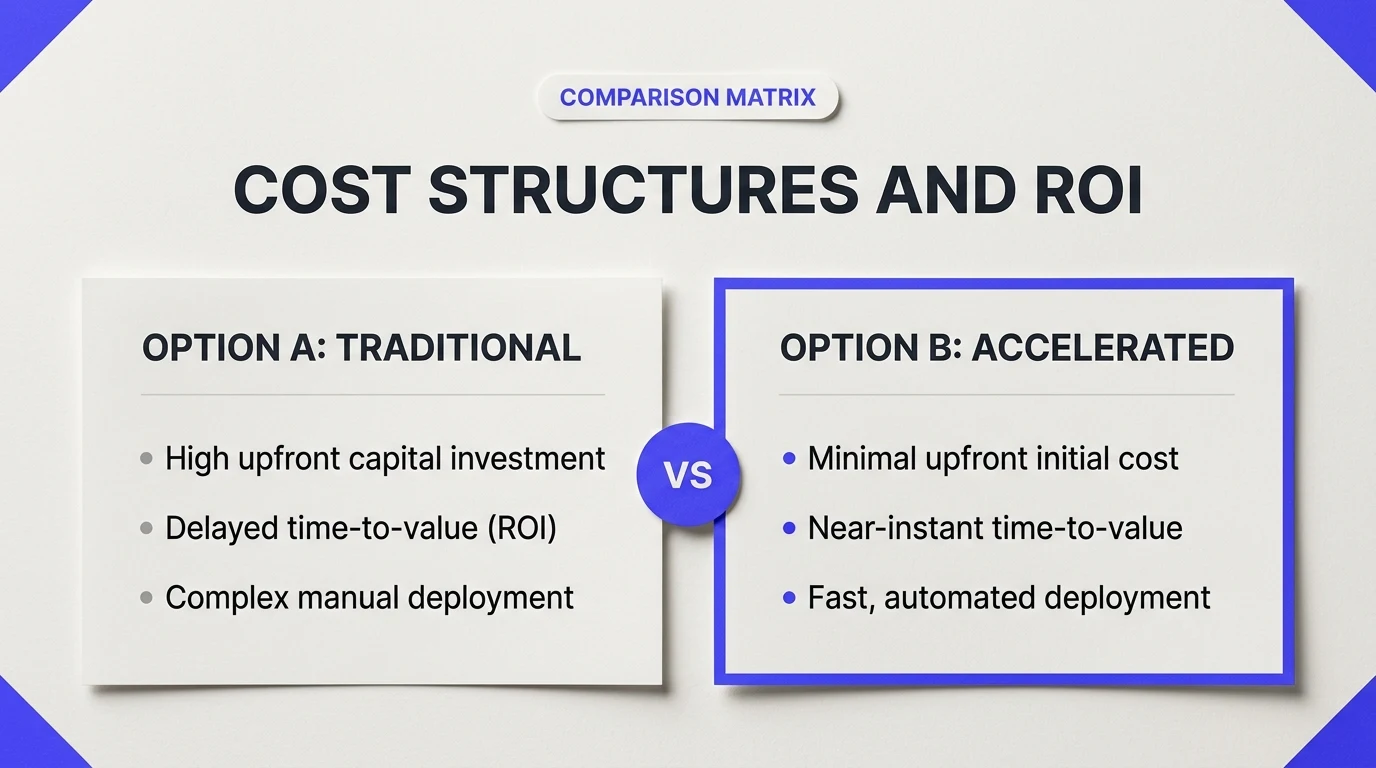
Every dollar in an e-commerce budget must pull its weight. When deciding where to allocate monthly software spend, retail brands inevitably face a strategic fork in the road: do you invest in acquiring customers faster, or do you invest in servicing and retaining them more efficiently? This is the fundamental trade-off at the heart of ecomas ai vs adcreative ai.
One platform focuses on creative velocity to slash Customer Acquisition Cost (CAC) at the top of the funnel. The other focuses on operational automation to protect margins and lift Lifetime Value (LTV) at the bottom. Understanding how their pricing tiers and credit systems convert into actual cash flow helps you avoid paying for software that doesn't move your balance sheet.
Balancing CAC Reduction and Margin Preservation in Ecomas AI vs AdCreative AI
AdCreative.ai operates primarily on a credit-based subscription model. You pay a baseline monthly fee that grants a set quota of download credits, brand profiles, and rendering access. For growth teams, the economic argument is simple: production speed. Hiring a freelance designer to build twenty banner variants can cost hundreds of dollars and take several days. Using automated generation cuts that asset creation time down to minutes.
This rapid turnaround directly attacks ad fatigue. On platforms like Meta and TikTok, ad performance typically degrades within two weeks as your audience gets tired of seeing the same image. By testing dozens of visual hooks and copy angles in rapid succession, you keep click-through rates high and acquisition costs low. However, community discussions around e-commerce operational benchmarks on Reddit frequently point out an overlooked risk: burning through generation credits on mediocre variations without a disciplined testing framework can quickly inflate your software overhead without lowering your blended CAC.
"Generating 100 creatives doesn't mean much if your support inbox is so backed up that first-time buyers cancel before their package ships. Creative velocity brings people through the door, but operations determine if you keep the profit."
Ecomas AI addresses the opposite side of the ledger. Instead of burning ad spend to capture net-new eyeballs, its pricing aligns with storefront interactions, customer ticket volume, and operational workflows. When evaluating ecomas ai vs adcreative ai, finance teams often find that operational savings offer a more predictable payback period. Automating standard post-purchase questions—such as order tracking, returns, and address changes—instantly removes repetitive labor from your payroll.
| Financial Dimension | AdCreative.ai (Creative Velocity) | Ecomas AI (Storefront Operations) |
|---|---|---|
| Core Billing Unit | Monthly creative generation & download credits | Storefront order volume & automated ticket resolutions |
| Primary Return Metric | Lower Customer Acquisition Cost (CAC) & higher ROAS | Preserved operating margin & higher Customer Lifetime Value (LTV) |
| Time to Realized Value | Rapid (hours to launch new ad sets) | Cumulative (weeks to deflect staff hours and retain buyers) |
| Cost Downside Risk | Unused credits expiring; running ad budget on unproven hooks | Underutilized workflows if monthly order volume drops |
Evaluating Setup Friction and Payback Horizons
Which platform delivers a faster return? The answer depends on where your business currently bleeds cash.
If your storefront has healthy profit margins and a functional support desk, but top-of-funnel ad fatigue is driving your customer acquisition costs through the roof, automated creative production pays for itself fast. A single breakout ad hook uncovered through high-volume multivariate testing can double your return on ad spend within a weekend.
Conversely, if you are spending heavily on ads while your customer support queue takes forty-eight hours to resolve simple delivery inquiries, pouring money into more ad iterations is like filling a leaky bucket. Support bottlenecks destroy repeat purchases. Ecomas AI shields your margins by turning post-purchase support from an expensive labor center into an automated, margin-protecting system that preserves repeat order revenue.
Calculate your immediate leak. When traffic acquisition is choking your growth, front-end creative generation provides the quickest lifeline. When staffing costs and post-click churn are eroding your gross revenue, operational automation delivers the most durable return on investment.
Which Solution Fits Your Business? Decision Criteria for Retail Brands
You can't fix a broken pipe by pumping more water through it. Similarly, driving paid traffic into an operational mess burns cash fast, while cleaning up a storefront that gets zero visitors creates a ghost town. Deciding between ecomas ai vs adcreative ai comes down to identifying your leakiest bucket and fixing that first.
Every dollar you spend on software should either lower your operational labor costs or increase your customer acquisition returns. The choice between creative generation and storefront workflow automation depends on where your business feels the sharpest pain today.
| Decision Metric | Lean Toward AdCreative.ai | Lean Toward Ecomas AI |
|---|---|---|
| Monthly Ad Spend | Over $5,000 across Meta, Google, or TikTok | Under $3,000, or heavily reliant on organic traffic |
| Primary Operational Drag | Ad creative burnout and escalating cost per click | Catalog maintenance, order syncs, and support queues |
| Team Composition | Media buyers and marketing specialists needing creative volume | Store operators and inventory teams managing daily workflows |
| Core Strategic Focus | Testing hooks and visuals to scale top-of-funnel reach | Protecting profit margins by cutting administrative hours |
Evaluating Ecomas AI vs AdCreative AI Across Core Growth Stages
Brand maturity shapes your immediate needs. Early-stage stores with modest product counts often face an acquisition problem rather than an operational one. When your catalog has only twelve items, managing inventory isn't eating your weekends. Your biggest issue is convincing cold shoppers to land on your product pages.
Ad algorithms burn through visual assets at an alarming rate. If you spend $10,000 a month on Meta, an ad creative that performed well on Monday can flatline by Thursday. AdCreative.ai directly targets this problem. It works like an on-demand junior design team, spitting out dozens of banner variations and copy angles in minutes so you don't run out of testing collateral.
"We realized our ad platform was choking not because our offer was bad, but because we were showing users the same two banners until they became blind to them."
Growth brings a different set of headaches. As your catalog balloons to hundreds or thousands of SKUs, the back-office wheels start shaking. Suddenly, product tags fall out of sync, stock discrepancies lead to refund requests, and customer questions pile up faster than your support team can answer them.
This is where operational automation matters most. Ecomas AI steps in to handle storefront intelligence and backend task management. It acts like an air traffic controller for your store operations, organizing listing data and handling repetitive tasks that otherwise drain your team's energy. Automating back-office work keeps your operations humming while protecting your fulfillment speed.
Consider output consistency before pulling the trigger. As many brand founders note in retail discussions on r/ecommerce regarding creative rendering benchmarks, automation tools only pay for themselves if your team doesn't spend hours fixing raw outputs. A tool that produces fifty graphics that need manual edits won't save you time. Pick the platform that addresses the bottleneck consuming your most expensive working hours.
Run through this quick sanity check to choose your starting path:
- Choose AdCreative.ai if your daily conversion rates are sinking due to creative fatigue, you have an active paid ads budget ready to deploy, and your design pipeline can't keep up with your media buyer's testing targets.
- Choose Ecomas AI if your store backend is disorganized, manual data entry eats into your working hours, and operational friction causes customer churn after the sale.
Don't adopt both tools at once if your resources are tight. Pick the single platform that relieves your most urgent operational headache, dial in its daily use over thirty days, and then reassess your next constraint.
Building a Cohesive Automation Stack for Long-Term E-Commerce Growth
Treating front-end customer acquisition and back-end order management as isolated departments is an easy way to bleed cash. Traffic without fulfillment is useless. Flawless fulfillment without steady traffic leaves warehouses empty. Growth happens when these systems work together like clockwork.
Founders often ask in Reddit's e-commerce store automation debates whether automating their creative pipelines and back-office tasks genuinely beats sticking to manual workflows. Small teams fear high software overhead and erratic outputs. Hand-crafting every banner and manually answering every support ticket feels safer. That safety vanishes the moment a product goes viral and your inbox drowns in delivery status requests.
When framing the comparison of ecomas ai vs adcreative ai, viewing them as direct rivals misses the bigger operational picture. High-growth retail setups do not pick between creative velocity and operational intelligence. They link them.
Synthesizing Ecomas AI vs AdCreative AI into a United Engine
Think of your e-commerce operation as a high-performance vehicle. AdCreative.ai acts as the accelerator pedal. It rapidly spins up visual angles, ad banners, and social headlines, letting you run multivariate tests on Meta and Google without burning out your internal designers. It solves asset exhaustion before ad costs spike.
Ecomas AI functions as the steering and suspension. Once that paid traffic lands on your storefront, operational systems must immediately take over. It handles customer inquiries, tracks order updates, helps organize back-end tickets, and keeps catalog data consistent across retail channels. When these two engines speak the same language, your business stops leaking margin.
Field Practitioner Rule: Never scale your top-of-funnel creative testing faster than your back-end support can handle. A winning ad campaign that produces a backlog of unanswered tickets ruins customer lifetime value faster than poor creative ever could.
Building this automated loop requires clear boundaries across your tech stack:
- Fuel the funnel: Deploy AdCreative.ai to generate fresh hooks and visual assets every week, rotating product displays to stop creative fatigue before click-through rates dip.
- Protect the purchase: Direct incoming traffic toward storefronts supported by Ecomas AI, ensuring customers get immediate answers to stock questions, shipping estimates, and return policies.
- Listen to customer tickets: Feed recurring customer objections back into your creative team. If customers constantly ask about sizing or ingredients in support chats, turn those answers directly into your next round of ad creatives.
- Audit before expanding: Set a strict monthly review to check software subscriptions against actual labor saved. Cut tools that add dashboard bloat without freeing up team hours.
Modern retail moves too fast for slow design cycles or sluggish back-office responses. Instead of guessing which tool wins in a head-to-head match, build a stack that captures attention cleanly on the front end and backs it up with rock-solid fulfillment on the other side. That balance is how modern digital storefronts grow without breaking.