How to Scale D2C Ads Using Autonomous AI
Every direct-to-consumer brand eventually hits an invisible wall where spending more money just burns cash faster. If you want to scale d2c ads using autonomous ai, you have to break through this creative burnout before rising customer acquisition costs kill your margins. Ad fatigue sets in within days now, not weeks. Your media buyers scramble to launch fresh hooks, variations, and angles, but manual production simply cannot outpace modern platform algorithms.
Table of Contents
- Breaking the Ad Fatigue Ceiling: Why Autonomous Systems Are Changing E-Commerce Growth
- How Does Autonomous AI Differ from Traditional Rule-Based Ad Automation?
- How to Scale D2C Ads Using Autonomous AI Across Multi-Channel Campaigns
- How Can Brands Automatically Generate High-Converting Creative Assets from Customer Data?
- Why Real-Time Autonomous Budget Allocation Outperforms Manual Media Buying
- How to Align Autonomous Paid Traffic with Conversational Post-Click Support
- Building a Resilient, Self-Optimizing Ad Engine for the Next Era of E-Commerce
The math behind traditional e-commerce media buying is broken. When Meta or TikTok push a winning creative to hundreds of thousands of shoppers, audience saturation happens overnight. Frequency climbs. Click-through rates tumble, and your cost per acquisition jumps by 40% before your team even opens Slack on Monday morning. By the time a designer edits three new video hooks and a copywriter adjusts the value proposition, you've already wasted thousands of dollars serving stale creative to tired audiences.
Growth leaders running high-volume storefronts know this cycle all too well. Founders in Reddit's SaaS community discussion on autonomous ad fatigue solutions often debate whether automated tools can match the creative nuance of an experienced growth team. The reality is simple: humans excel at high-level brand strategy and emotional empathy, but human hands are far too slow to manage twenty distinct audience micro-segments across four separate ad networks.
Autonomous AI agents represent a fundamental shift in how direct brands operate paid acquisition. Instead of forcing teams into endless spreadsheet audits, these engines monitor performance minute by minute. Tools like Madgicx provide predictive budget controls, while modern generative systems instantly remix customer reviews, high-performing video clips, and lifestyle photography into dozens of conversion-ready assets. When an ad shows early signs of decay, the system swaps out hooks, shifts budget toward high-margin audiences, and kills underperforming variants without manual intervention.
Adopting these workflows changes the economics of digital commerce. Learning how to scale d2c ads using autonomous ai removes the operational bottlenecks that hold growing stores back, giving your team the power to deploy hyper-personalized creative at machine speed while keeping acquisition costs under control.
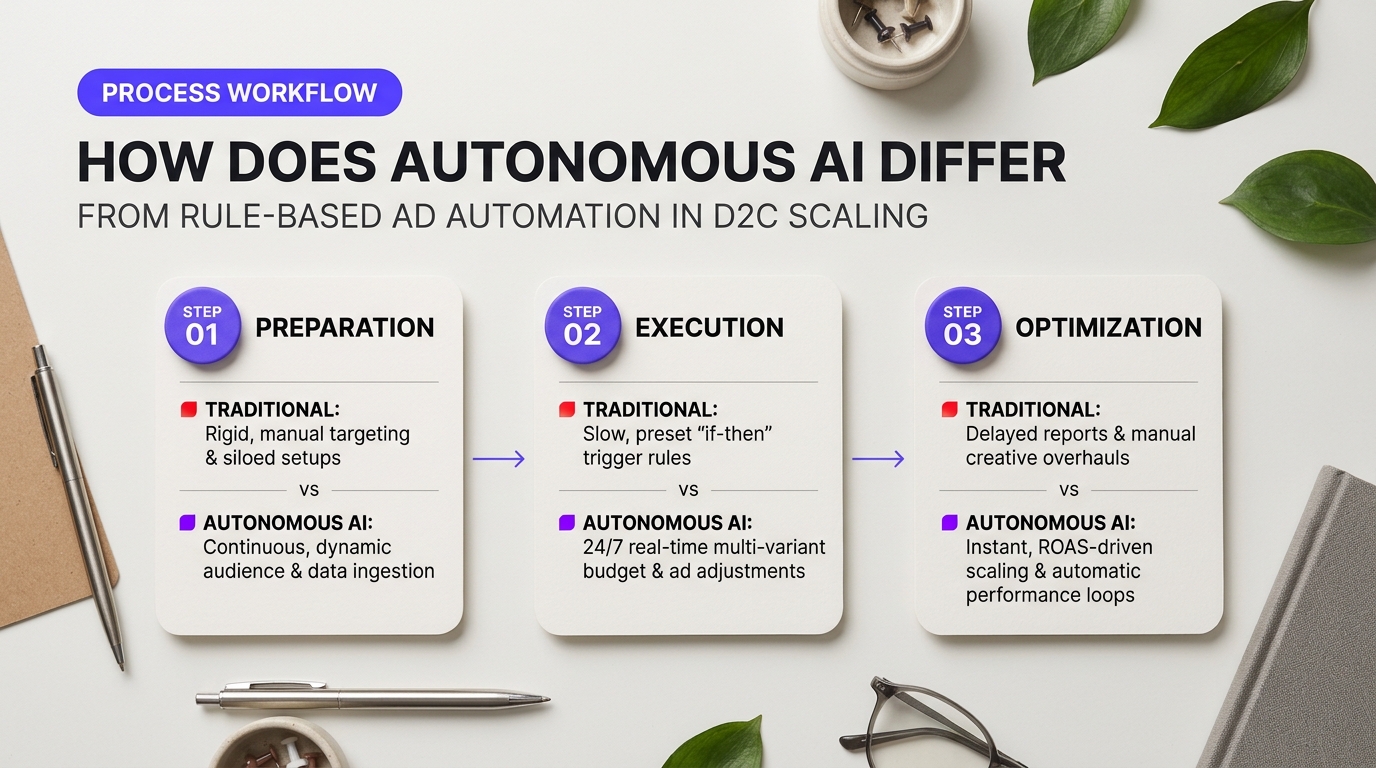
How Does Autonomous AI Differ from Traditional Rule-Based Ad Automation?
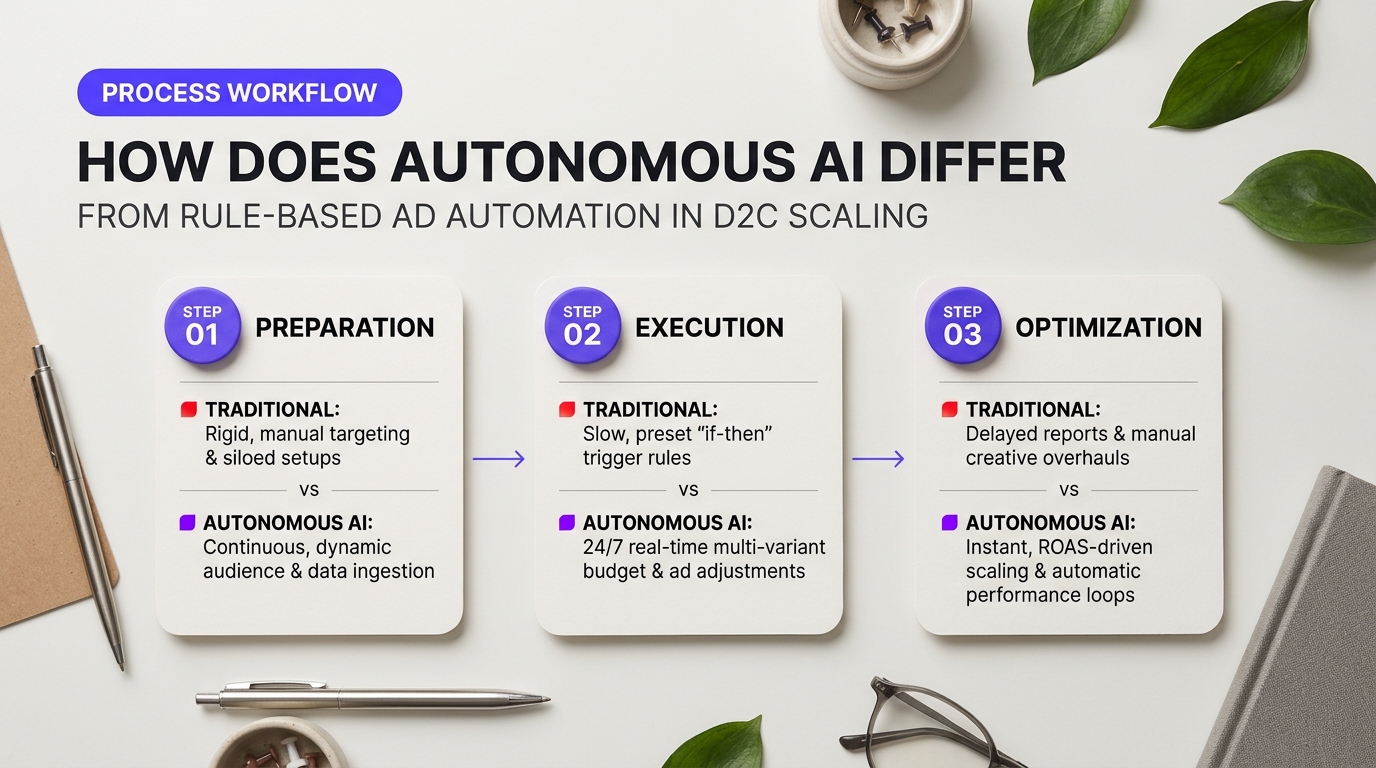
Most media buyers know the drill. You set up a platform rule inside Meta or Google Ads: "If cost per acquisition rises above $45 over the last three days, turn the ad set off." You go to sleep thinking your spend is safe. You wake up to find your best-performing top-of-funnel creative completely paused because of an attribution reporting delay. Meanwhile, a seasonal spike in demand was just starting, and your competitor swept up the orders.
That is the reality of traditional rule-based ad automation. It operates on simple "if-this-then-that" logic. Think of traditional automation like basic cruise control on an older car. It holds your speed at 65 miles per hour no matter what. If traffic stops suddenly or a deer runs into the road, cruise control will still drive straight ahead at full speed until you hit the brake. Autonomous agentic AI, by contrast, is a self-driving system. It reads lane markers, monitors surrounding vehicles, checks weather conditions, and maneuvers around obstacles in real time.
Why Brands Trying to Scale D2C Ads Using Autonomous AI Must Move Past Static Rules
Static rules evaluate single metrics in vacuum-sealed isolation. They cannot read between the lines. If a TikTok awareness campaign sends high-intent traffic that converts on Google Search two days later, a basic platform rule sees zero direct conversions on TikTok and shuts the ad down. It cannot connect the dots.
When you scale d2c ads using autonomous ai, the underlying machine learning models work as unified agents rather than isolated triggers. These models do not wait for human-set thresholds. Instead, they continually execute four interconnected functions across your entire growth stack:
- Multi-Touch Attribution Mapping: Rather than crediting only the first or last click, agentic models track how impressions across different platforms influence overall cart value. If an ad on Instagram creates strong search lift on Amazon or Google, the system keeps it funded even if platform ROAS looks low on surface dashboards.
- Predictive Purchase Intent: Traditional rules react to historical data—what already happened yesterday. Autonomous engines evaluate live user engagement, on-site scroll depth, video completion velocity, and seasonal cohort habits to predict what buyers will do in the next six hours.
- Audience Signal Synthesis: Autonomous systems bridge disparate data silos. They tie Shopify purchase frequencies, email open rates from Klaviyo, and live ad interaction signals into a cohesive customer profile, adjusting target audiences automatically.
- Autonomous Parameter Adjustment: Instead of binary on-or-off decisions, autonomous agents tweak bids by pennies, shift percentage shares of daily budgets, swap copy angles, or reallocate spend toward higher-margin inventory without waiting for a marketer to approve a change.
"The biggest shift isn't speed—it's perspective. Rules tell an ad account what to do based on what failed yesterday. Autonomous agents decide what to do based on what will profit tomorrow."
A frequent debate across marketing forums revolves around whether this shift is worth the investment for emerging brands. A common question raised in media buyer discussions on ad automation benchmarks is how autonomous agentic platforms compare to legacy tools like Revealbot or native automated rules. Legacy tools simply execute pre-written scripts faster than a human fingers can click. Modern autonomous platforms like Triple Whale’s smart attribution modeling or Madgicx’s autonomous execution agents actually analyze underlying trends, running probabilistic models to determine the optimal next action.
| Operational Dimension | Rule-Based Automation | Autonomous Agentic AI |
|---|---|---|
| Decision Logic | Static thresholds (e.g., IF CPA > $50 THEN pause) | Multi-variable, probabilistic machine learning models |
| Data Scope | Siloed in-platform metrics (Meta clicks, Google CPA) | Omnichannel signals, blended MER, warehouse inventory levels |
| Action Execution | Binary toggles (pause, activate, raise budget by 20%) | Dynamic micro-adjustments to bids, creatives, and budget splits |
| Handling Attribution Lag | Fails often; shuts off campaigns before sales register | Estimates conversion delays using cohort purchase velocity |
D2C founders often worry about letting software manage real money. That skepticism is healthy. Early ad tech tools frequently burned budgets when platform APIs lagged or tracking pixels misfired. Autonomous AI avoids those traps by setting hard guardrails instead of rigid rules. You define the high-level boundary conditions—such as minimum contribution margin or maximum daily spend caps—and let the agents test micro-variables within that safe territory.
The difference comes down to flexibility. Rigid platform rules punish variance. Autonomous models leverage variance to uncover hidden revenue opportunities that human media buyers never have the time to spot.
How to Scale D2C Ads Using Autonomous AI Across Multi-Channel Campaigns
Managing ad campaigns across multiple networks manually feels like spinning plates during an earthquake. A media buyer adjusts bids on Meta, checks TikTok creative fatigue, and reallocates budgets into Google Performance Max. By the time they finish their morning coffee, half the daily budget has drifted into underperforming placements. Autonomous AI eliminates this reactive scramble. Instead of reacting to yesterday's numbers, self-directing systems use live event streams to rebalance spend, spin up dynamic assets, and capture high-intent demand around the clock.
When you scale d2c ads using autonomous ai across fragmented networks, the engine treats Meta, Google, and TikTok as a unified conversion pipeline rather than separate operational silos. It balances real-time efficiency against long-term customer acquisition costs automatically.
A Step-by-Step Blueprint to Scale D2C Ads Using Autonomous AI
Transitioning from manual campaign tweaks to full autonomous execution requires clear system rules. Here is how modern direct-to-consumer brands structure their multi-channel growth engine:
1. Deploy Continuous Multivariate Creative Testing
Traditional A/B testing is painfully slow. You change a headline, wait four days for statistical significance, and burn through thousands of dollars. Autonomous creative engines dismantle ads into modular building blocks: 3-second video hooks, product demonstrations, customer testimonials, and distinct calls to action. Platforms assemble these pieces dynamically into dozens of rendered variations. When performance indicators signal that a hook is fatiguing on TikTok, the model instantly swaps in a new visual angle while keeping the high-converting audio track intact.
2. Automate Cohort Discovery from First-Party Signals
Standard lookalike audiences degrade rapidly under aggressive privacy filters. Instead of relying on static audience lists, autonomous systems ingest live zero-party data, such as post-purchase survey responses and real-time checkout attributes. The system maps distinct buyer cohorts by intent and motivation. A customer buying an electrolyte drink for marathon training sees athletic endurance hooks, while someone shopping for hydration recovery gets lifestyle-oriented wellness messaging—all mapped programmatically without human ad set creation.
3. Enable Predictive Cross-Channel Liquidity
Think of your overall ad spend as a single pool of water. Manual workflows keep cash locked into rigid buckets: $3,000 for Meta, $1,500 for TikTok, and $2,000 for Google PMax. If search demand drops on a Tuesday afternoon because a competitor launches an aggressive promo, manual media buyers keep bleeding cash. Predictive liquidity algorithms evaluate marginal cost per acquisition (mCPA) every fifteen minutes. If TikTok is generating cheaper first-time buyers right now, capital flows there instantly.
| Operational Dimension | Manual Media Buying | Autonomous AI Engine |
|---|---|---|
| Creative Testing Velocity | 3–5 static variants per week | 50–200 modular variations tested daily |
| Budget Reallocation Speed | Daily or weekly retrospective reviews | Real-time micro-shifts every 15–30 minutes |
| Cross-Channel Attribution | Siloed platform ROAS with double-counting | Unified incremental blended revenue tracking |
| Audience Targeting | Manual lookalikes and interest groups | Dynamic behavioral clustering via first-party data |
Evaluating Platform Orchestration Tools
Connecting Meta Advantage+, Google Performance Max, and TikTok Smart Creative requires an external orchestration brain. Off-the-shelf platform algorithms optimize inside their own walled gardens. They don't know what happens on other channels. That's why cross-channel brands lean on specialized platforms to connect the dots.
Tools like Smartly.io and Madgicx offer distinct approaches to this challenge. Smartly excels at heavy catalog workflows and dynamic modular creative rendering for enterprise catalogs, making it ideal for brands with thousands of SKUs. Madgicx fits leaner teams that need quick predictive budget triggers and creative scoring across Meta and Google without complex engineering overhead. Whichever tool you select, ensure it integrates direct-to-consumer store metrics from Shopify instead of trusting self-reported platform pixels.
"The biggest trap brands fall into is turning on autonomous tools without strict boundary rules. The system won't care if it burns your entire monthly budget in six hours if you forget to set maximum hourly bidding caps."
Marketers frequently raise this exact concern in community discussions on autonomous campaign pitfalls. An autonomous system requires firm guardrails to prevent algorithmic runaways. You must set floor efficiency metrics, such as a minimum target return on ad spend (tROAS) or maximum acquisition cost caps. If conversion rates suddenly spike downward across an entire channel—due to a broken checkout button or payment gateway outage—the AI halts spend before the account drains empty.
Start small. Don't hand over 100% of your multi-channel media budget on day one. Give autonomous systems 20% of your overall monthly testing budget to run creative iteration and liquidity distribution against your manual campaigns. Once the algorithmic workflows beat your internal benchmarks on blended customer acquisition cost for three consecutive weeks, expand spend gradually across the rest of your channels.
How Can Brands Automatically Generate High-Converting Creative Assets from Customer Data?
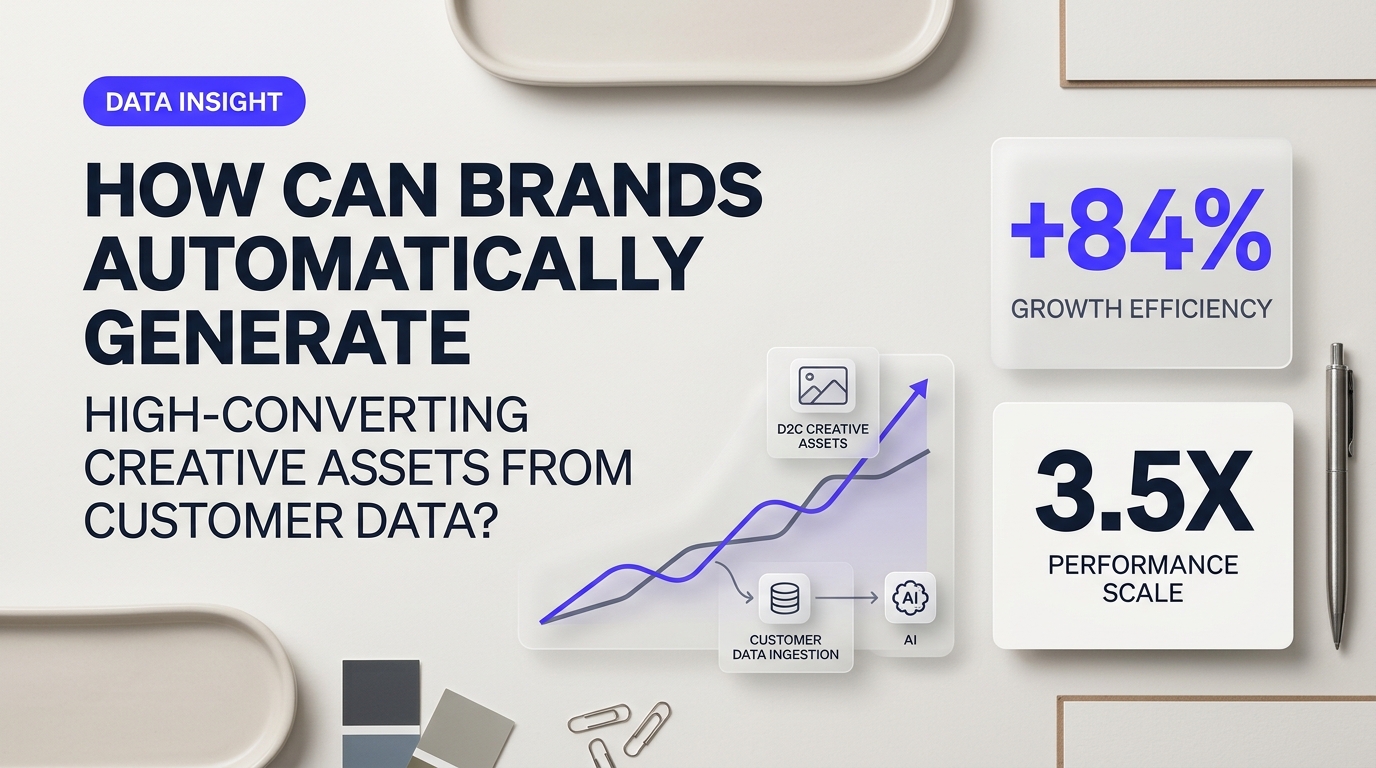
Most marketing teams hit a brick wall because they design ads inside an echo chamber. Copywriters and designers guess what might grab attention, build five variations in Figma, and wait two weeks for performance data. That process is too slow. The most effective ad copy is never written from scratch; it's borrowed directly from real buyers.
Your business already owns the ultimate creative playbook. It hides inside Zendesk and Gorgias support tickets, three-star reviews on your product pages, and post-purchase survey forms. When a customer writes, "I loved the serum, but I almost didn't buy it because I thought it would leave my skin sticky," they've handed you a proven hook. They've pinpointed the exact fear holding back thousands of window shoppers.
Transforming Customer Objections to Scale D2C Ads Using Autonomous AI
Autonomous creative platforms ingest these sprawling text databases and turn raw customer sentiment into high-converting visual and copy variants. When you scale D2C ads using autonomous AI, you stop testing random creative angles and start deploying direct answers to customer hesitation.
The system constantly parses sentiment patterns across your operational data. It isolates common friction points—shipping doubts, sizing confusion, or texture concerns—and feeds them into generative frameworks trained on your brand guidelines. Within seconds, it produces tailored hooks and visual variations mapped to customer hesitation:
| Customer Data Signal | AI-Detected Hesitation | Autonomous Creative Asset |
|---|---|---|
| Support tickets asking about returns for half-sizes. | Fear of picking the wrong fit and dealing with annoying return labels. | Split-screen video ad showing a true-to-fit measure overlay with dynamic copy: "Between sizes? Here's why our toe box won't pinch." |
| Reviews mentioning the material softens up after three washes. | First-touch skepticism about initial out-of-the-box stiffness. | Macro product graphic with kinetic text: "Stiff at first? That's raw Japanese denim doing its job. Watch wash #3." |
| Post-purchase surveys stating, "I bought this for hot summer runs." | Unclear seasonal versatility in existing brand imagery. | AI swaps indoor studio backgrounds for sun-drenched canyon trails, paired with sweat-wicking comparison callouts. |
Visual consistency is where many brands get nervous. As highlighted across r/ecommerce community debates on automated asset production, founders often worry about off-brand hallucinations, weird visual artifacts, and unnatural rendering. Nobody wants an AI tool inventing an extra sleeve on a jacket or distorting a company logo.
Modern autonomous engines don't build entire images out of thin air. Instead, they work like modular assembly lines. They preserve your original studio-shot product photography down to the exact pixel. The generative engine simply builds contextual backgrounds around your verified asset, applies approved brand color palettes, and generates typography based on validated review phrases. If reviews show nurses love your slip-on shoes for twelve-hour hospital shifts, the tool swaps your neutral studio background for a realistic hospital corridor while leaving the shoe untouched.
"The magic isn't generating random art; it's matching a customer's unspoken fear with a tailored visual counter-argument the instant that fear becomes a trend in your support inbox."
This automated loop creates an ongoing feedback engine. When customer service logs flag an uptick in questions about material durability, the system notices. It pulls the top five quotes from verified long-term owners and spins up fresh image carousels and motion graphics highlighting rugged wear. Your creative production speeds up from weeks to minutes, directly answering what buyers care about most.
Why Real-Time Autonomous Budget Allocation Outperforms Manual Media Buying
Manual media buying runs on an outdated premise: that a human reviewing performance metrics two or three times a day can react fast enough to maximize ad spend efficiency. Ad networks like Meta and TikTok operate high-frequency ad auctions. Ad costs, audience engagement, and conversion intent fluctuate every single minute. When growth teams attempt to scale d2c ads using autonomous ai, the sharpest advantage comes from eliminating this human reaction latency.
Human buyers usually adjust budgets looking through the rearview mirror. They look at yesterday's ROAS, blended CPA, or morning dashboard readouts, then manually nudge budgets up or down. If a specific creative angle burns out at 10:00 AM, a human rarely spots the drop until late afternoon. By then, hundreds or thousands of dollars have vanished into non-converting impressions.
"We realized our media buyers spent 70% of their day babysitting ad sets instead of testing new concepts. Once we handed intra-day pacing to an algorithm, our blended CPA dropped 22% in three weeks."
Scale D2C Ads Using Autonomous AI: Real-Time Precision vs. Static Spreadsheets
Autonomous budget allocation treats ad spend the way modern algorithmic trading treats equities. Instead of checking account health every few hours, the system assesses cross-channel signals every 5 to 15 minutes. It evaluates conversion probabilities against historical trends, external tracking pixels, and inventory availability.
| Workflow Dynamic | Manual Media Buying | Basic Rules (e.g., Revealbot) | Autonomous AI Engines |
|---|---|---|---|
| Adjustment Frequency | 1–3 times daily | Hourly checks (fixed intervals) | Continuous (intra-day micro-shifts) |
| Decision Logic | Human intuition & lagging ROAS | Rigid If/Then thresholds | Multi-signal predictive modeling |
| Fatigue Detection | 24–48 hours after CPA spikes | Only after spend breaches rules | Hours before CPA spikes |
| Surge Capitalization | Missed or caught late | Fixed incremental steps | Dynamic capital concentration |
Catching Creative Burnout Hours Before ROAS Collapses
Ad fatigue does not happen all at once. It whispers before it screams. The earliest indicators are rarely bottom-line conversions; they are upstream telemetry metrics. First-time impression ratios drop. Outbound click-through rates decline. Video hold rates at the three-second and ten-second marks soften. Cost per thousand impressions (CPM) creeps up as the algorithm works harder to find receptive eyeballs.
A manual buyer will not pause an ad set showing a 3.5x ROAS at noon, even if engagement velocity has cratered. An autonomous agent detects the drop in audience receptivity immediately. It calculates that the current ad set will miss its target efficiency by 4:00 PM if spend holds steady. The system throttles that ad's budget in real time, shifting capital toward healthy creative variants that still hold strong click-to-purchase ratios.
Seizing Spontaneous Conversion Surges
The inverse scenario is equally profitable: sudden, unpredictable demand spikes. A competitor runs out of stock, a micro-influencer shares an organic review, or a specific audience cohort becomes active on mobile during lunch hours. Conversion rates on a specific product page or ad hook suddenly double.
When you scale d2c ads using autonomous ai, the system recognizes anomalous positive conversion velocity within minutes. Instead of waiting for a weekly budget review, the algorithm pumps ad spend directly into the winning angle while consumer intent peaks. When the surge subsides, the engine pulls spending back down to maintenance levels. It avoids overspending into empty impressions during off-peak evening hours.
Is Real-Time Allocation Worth the Investment for Smaller Brands?
Brand operators frequently wonder whether autonomous media buying pays off for stores spending under $20,000 monthly. As seen in Reddit community discussions on media buying software vs manual workflows, early-stage brands worry about platform subscription fees eating into gross margins.
For brands spending less than $5,000 monthly, native ad platform features like Meta Advantage+ or Google Performance Max handle basic pacing adequately. At that volume, data density is low, so third-party machine learning models struggle to find statistically significant signals faster than platform defaults.
The inflection point happens around $15,000 to $30,000 in monthly ad spend. At this scale, third-party software costs (typically $200 to $1,500 monthly for platforms like Madgicx or specialized predictive allocation engines) pay for themselves rapidly. Eliminating even 10% of wasted ad spend on fatigued creative while capitalizing on mid-day conversion spikes recovers more capital than the software subscription costs.
Avoiding the Common Automation Edge Cases
Autonomous systems need clear boundaries. Unconstrained algorithms can amplify mistakes if you don't install proper guardrails:
- Set Hard Ceiling Caps: Prevent algorithmic runs where a temporary conversion cluster causes the system to dump 80% of a daily budget in ninety minutes.
- Incorporate Stock Out Checks: Connect inventory levels to your ad bidding engine via API. If an SKU dips below 15 units, the budget on related ads should throttle automatically regardless of how high ROAS looks.
- Account for Attribution Delay: Server-side tracking (CAPI) and post-purchase surveys often take minutes to hours to settle completely. Autonomous engines should weigh predictive leading indicators rather than relying strictly on instantaneous pixel fires.
Leaving budget management to manual toggles and static spreadsheets caps your growth ceiling. Intra-day algorithmic reallocation ensures every ad dollar flows to where intent is highest right now, shielding your bottom line while your team focuses on high-impact creative production.
How to Align Autonomous Paid Traffic with Conversational Post-Click Support
Autonomous ad engines drive shoppers to your storefront with surgical accuracy. They test hundreds of angle variations, shift budgets in milliseconds, and pinpoint buyers ready to open their wallets. Getting the click is only half the battle. If visitors land on a static page with unanswered questions about shipping times, ingredients, or sizing, they leave. That paid click goes down the drain.
Think of it like running a luxury brick-and-mortar boutique. Your marketing team stands on the street bringing hundreds of qualified shoppers through the front doors. Once inside, those shoppers find an empty floor with no sales clerks anywhere in sight. Most will browse for thirty seconds, get confused, and walk out.
How to Scale D2C Ads Using Autonomous AI Without Post-Click Drop-Off
When you scale d2c ads using autonomous ai, traffic volume surges overnight. Human support reps cannot keep up with thousands of concurrent visitors asking nuanced pre-purchase questions at two in the morning. Automated conversational funnels bridge this gap by acting as an always-on digital sales floor.
The secret lies in passing campaign context directly into the post-click experience. When an autonomous ad targets a shopper with creative focused on sensitive skin, the landing page shouldn't greet them with a generic welcome. The conversational AI reads the incoming campaign parameters and opens with a tailored prompt: "Looking for our hypoallergenic formula? Here is how it compares to our standard line."
"Sending traffic to a static page without dynamic objection-handling killed our ROAS as we scaled. Once our chat agent started acknowledging the exact ad angle the user clicked, on-site conversion jumped 28% in three weeks."
This continuity reassures the shopper. It instantly confirms they landed in the right spot, cutting down bounce rates on cold traffic.
| Landing Page Experience | Shopper Action | Impact on Ad Efficiency |
|---|---|---|
| Static Product Page | Hunts through FAQs, gets unsure about sizing, bounces. | Wasted ad spend; lower return on ad spend (ROAS). |
| Context-Aware AI Assistant | Asks sizing questions, receives instant fit advice, adds to cart. | High conversion rate; faster algorithm feedback loops. |
Trying to scale d2c ads using autonomous ai while leaving landing pages completely unassisted burns budget on confused shoppers. Real-time conversational agents catch hesitant visitors right before they exit. They answer ingredient queries, clarify return policies, and recommend bundle tiers based on cart values.
Selecting the Right Conversational Engine for D2C Growth
E-commerce teams often ask whether a rule-based chatbot is enough or if a true generative agent is necessary. Rigid decision-tree bots often frustrate mobile shoppers because they fail as soon as someone types a natural question outside the script.
Modern platforms like Gorgias AI Agent and Siena AI solve this by connecting directly to your product catalog, reviews, and inventory levels. Gorgias works exceptionally well for Shopify brands that need tight integration with helpdesk ticketing and instant order tracking. Siena AI shines when brands want hyper-empathic, brand-voiced sales interactions that mimic an in-store stylist.
Cost is an understandable concern for leaner brands. Entry tiers for conversational AI tools typically start between $150 and $400 per month, scaling based on chat volume. While that sounds like an added overhead, recovering just three to four abandoned carts per week pays for the entire platform.
Beware of unconstrained setup traps. As seen in discussions on conversational post-click pitfalls, brands running poorly configured generative agents face hallucinated discount codes or inaccurate product claims. Keep your bot constrained to your verified knowledge base. Set strict guardrails so the assistant defers out-of-bounds questions to email support rather than guessing.
Match your fast-learning ad creative with an equally smart landing environment. Your media buying engine will get high-intent shoppers through the door. Your conversational layer will make sure they walk out with a receipt.
Building a Resilient, Self-Optimizing Ad Engine for the Next Era of E-Commerce
Manual media buying has hit a hard ceiling. Staring at dashboards, manually tweaking bids by fifty cents, and swapping ad creative at midnight won't build an enduring brand. High-velocity auction dynamics and fragmented customer journeys move too fast for manual spreadsheets. Modern digital growth requires a self-correcting machine. When you run an autonomous infrastructure, your ad spend reacts to conversion signals in seconds rather than days.
Many store owners hesitate before handing the keys to machine intelligence. As marketers often note in Reddit debates on ad automation output quality, fears around bizarre copy variations, budget burn, and broken tracking pixels are real. Autonomous tools without clear guardrails can waste money on the wrong audiences. The winning brands don't give artificial intelligence blind control. They set strict floor targets for customer acquisition costs, define brand vocabulary rules, and let the software handle high-volume creative testing and budget distribution.
Practical Steps to Scale D2C Ads Using Autonomous AI Alongside Retention
Customer acquisition is only half the battle. If your paid ads bring shoppers in the front door while retention fails, your unit economics collapse. To truly scale d2c ads using autonomous ai, you must link your paid campaigns directly to customer retention engines. Pairing attribution engines like Triple Whale with predictive messaging platforms like Klaviyo shows how connected data feeds bottom-line growth. When a machine-learning engine spots that a specific creative angle attracts buyers with higher 90-day repeat purchase rates, it shifts budget toward that creative without waiting for human permission.
Marketing managers should begin this shift with three practical adjustments:
- Audit your tracking foundation: An autonomous system only performs as well as the event signals you feed it. Set up clean server-side tracking so first-party purchase signals flow without browser drop-offs.
- Build strict creative parameter fences: Feed your generative engines approved brand palettes, verified customer reviews, and clear product angles. This prevents bizarre copy while generating fresh visual assets every week.
- Sync inventory to ad delivery: Connect live warehouse feeds directly to ad managers. Stop wasting ad dollars pushing items that are out of stock in popular sizes.
The future belongs to lean marketing teams running smart growth systems. Handing repetitive media management to algorithms frees your team to focus on great product design, customer relationships, and bold creative concepts. Build the engine today, protect your margins, and let the system scale your business while you sleep.