How to Build an AI Product Studio for D2C
The old playbook of spending eighteen months and two million dollars to launch a single direct-to-consumer software brand is officially broken. Today, forward-thinking operators choose to build an ai product studio to test, ship, and scale multiple automated direct-to-consumer (D2C) solutions simultaneously under one roof. When intelligence is accessible via an API, betting everything on one isolated product is no longer a smart gamble. It's an unnecessary risk.
Table of Contents
- Why the AI Venture Studio Model Is Replacing Traditional Startup Creation
- What Is an AI Product Studio and How Does It Differ From an Agency?
- How to Build an AI Product Studio: A Step-by-Step Blueprint
- Who Do You Need to Hire First for an AI Studio Team?
- How to Build a Reusable AI Tech Stack and Shared Infrastructure
- How Does an AI Product Studio Validate Ideas in Under 30 Days?
- How Should You Structure Equity, Spin-Outs, and Investor Capital?
- How Do AI Studios Protect Their Products From Fast Commoditization?
- Scaling Your Studio Engine: From First Launch to an Enduring Portfolio
Foundation models changed the mathematics of software overnight. Writing code used to be the main expense for any tech business. Now, natural language models produce functional scripts, user interfaces, and database schemas in seconds. Anyone with a laptop can assemble a minimum viable product over a single weekend. Because building has become so easy, thousands of copycat tools hit the market every day. Standing out has never been harder.
This dynamic creates a serious dilemma for founders and investors. If software creation costs drop toward zero, defensibility based purely on code disappears. Many founders ask whether the studio model can really outperform classic solo founding setups. In fact, operators debating the venture studio model on Reddit openly question how product consistency and output quality hold up when compared against traditional manual workflows. They worry about building shallow wrappers that break down the moment underlying platform APIs update.
That is exactly why the venture studio approach is winning. Instead of raising capital for one unproven bet, an AI studio functions like a reusable laboratory. You share central design systems, growth flywheels, and backend foundations across a portfolio of targeted mini-apps. Teams leverage modern development environments like Cursor for lightning-fast code generation alongside scalable backends like Supabase to spin up auth and relational databases in minutes. When you decide to build an ai product studio targeted at commerce problems, you decouple business discovery from engineering bottlenecks. You test five sharp hypotheses at once, kill the four that fail to convert, and double down on the single breakout concept with proven customer demand.
Traditional startups carry heavy overhead. They hire full engineering teams before they ever confirm someone wants to buy what they're making. The studio flips that sequence on its head. It treats company building as an assembly line of validated learning, shared resources, and rapid customer feedback. The result is lower burn, faster iterations, and a repeatable path to profitable ownership in an AI-driven economy.
What Is an AI Product Studio and How Does It Differ From an Agency?
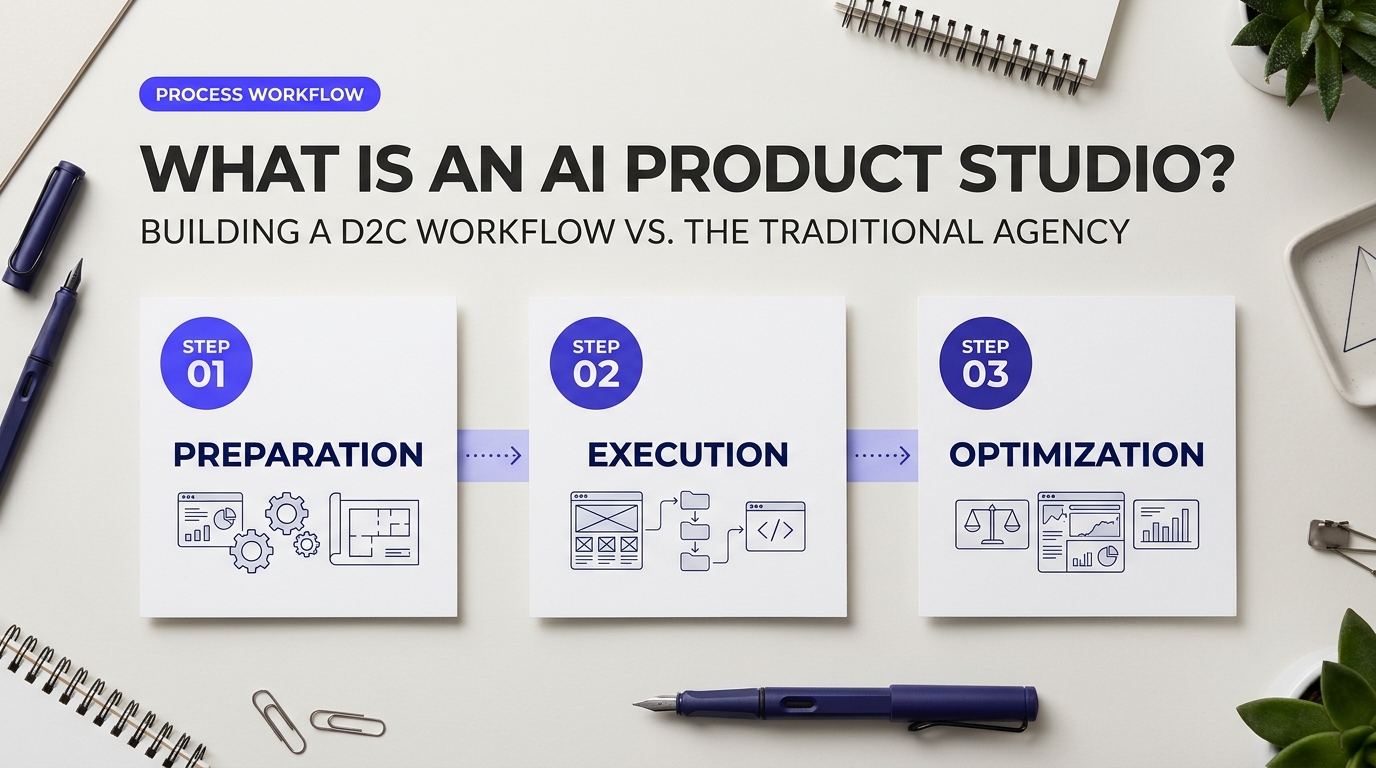
At a glance, an AI product studio looks a lot like a software agency. Both house elite engineers, ship functional software fast, and live on the frontier of generative tech. But their business engines run in opposite directions. Agencies sell client hours. AI studios manufacture proprietary software assets.
When you run an agency, every line of code belongs to the client who paid for it. If you discover a breakthrough prompt chain for D2C product catalog enrichment, you hand the keys over and start at zero with the next contract. When you build an ai product studio, you stop renting out your team's brains. Instead, you build a shared foundation once and use it to spin up multiple revenue-generating products under your own corporate umbrella.
Why Teams Choose to Build an AI Product Studio Over an Agency
Traditional venture builders assemble external founding teams, raise large blind pools of venture capital, and build standalone companies from scratch. That model is slow. It burns cash on recruitment, bespoke tech stacks, and duplicate operational costs. Agencies move faster, but they have zero equity upside.
An AI product studio bridges this gap by acting as a repeatable software foundry. It relies on three operational pillars:
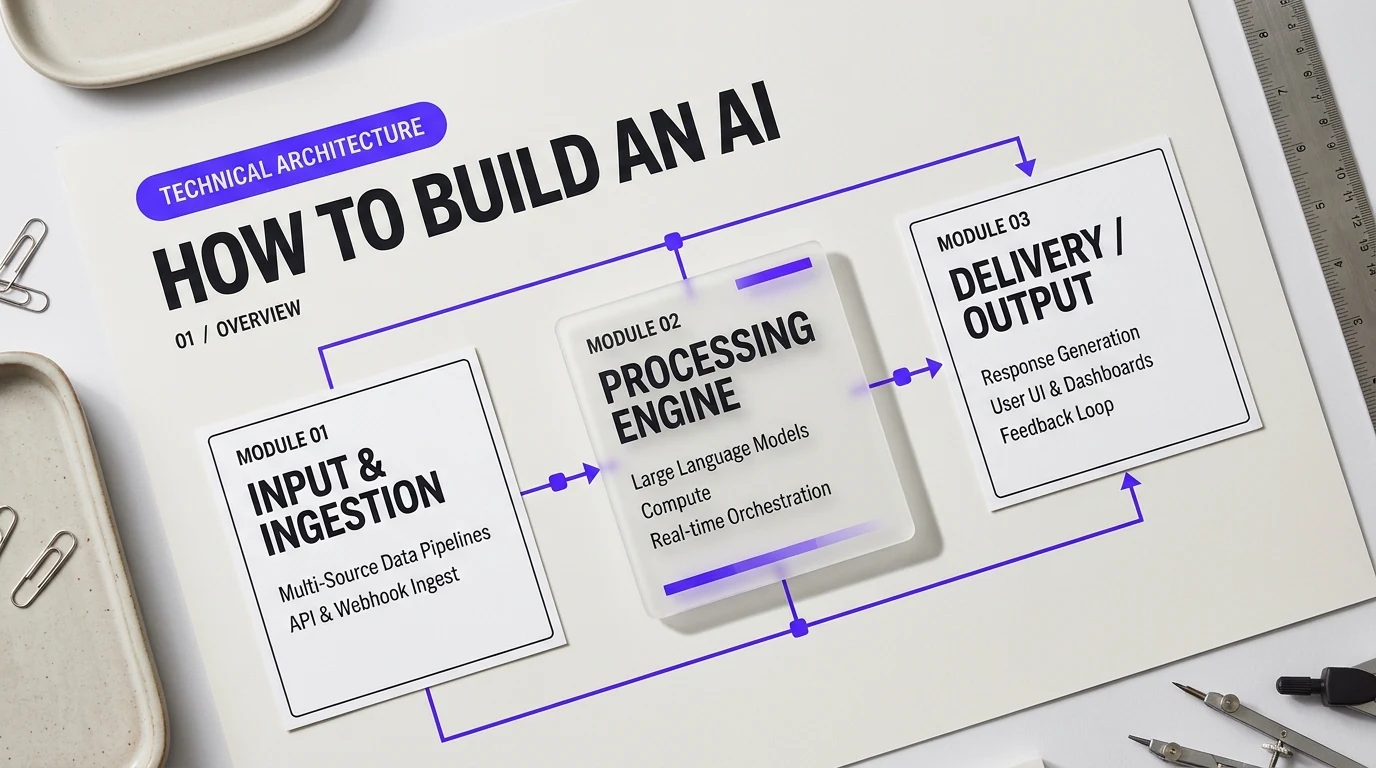
- Shared Technical Scaffolding: Instead of coding each app from the ground up, the studio maintains an internal platform layer. Shared authentication, billing, agent memory, and vector search pipelines live in a central repository. Launching a new D2C marketing app takes days, not months.
- 100% Equity Retention: The studio owns the intellectual property from day one. You fund development internally or via specialized studio funds, keeping the equity until a validated product spins out into a standalone entity.
- Modular IP Compounding: Every tool developed for one project feeds into the studio library. If you construct an automated product photography pipeline using ComfyUI and LangSmith for production tracing, that entire workflow becomes a plug-and-play module for your next e-commerce tool.
| Metric | Digital Agency | Venture Builder | AI Product Studio |
|---|---|---|---|
| Revenue Model | Hourly billable rates or fixed project fees | Management fees & fund carry | Direct software ARR & exit equity |
| Code & IP Rights | Transferred to client upon payment | Owned by the spun-out company | Retained inside the central studio holding company |
| Tech Reusability | Low; client contracts restrict reuse | Moderate; varies by company stack | High; central microservices shared across all apps |
| Scale Mechanism | Linear hiring to bill more hours | Hiring dedicated CEOs and founders | Asymmetric software margins across a portfolio |
A frequent debate in the software community centers on whether studios can maintain focus. As highlighted in a candid Reddit SaaS discussion on studio models, many operators worry that teams end up running a chaotic hybrid agency when cash gets tight, diluting product execution. That risk is real. Studios stumble when they accept bespoke client work to cover burn rates instead of investing in their own tech stack.
"The trap is calling yourself a studio while operating like a development shop. If you're building custom features on demand for someone else's cap table, you're an agency. Studios build assets that pay rent back to the holding company."
For founders targeting D2C brands, an AI studio offers an unfair speed advantage. Brand owners want automated catalog ingestion, predictive inventory ordering, and hyper-personalized creative assets. A studio can launch an AI copy optimizer, test it across twenty partner brands, scrap it if churn is high, or plug the underlying model weights into a new visual merchandising tool the following week. You build your enterprise value by owning the pipeline, not by sending an invoice for your hours.
How to Build an AI Product Studio: A Step-by-Step Blueprint
Building a venture studio isn't like launching an everyday SaaS startup. You aren't rolling the dice on one product. You're building an assembly line that manufactures products, validates them, and spins them out as independent companies. When you build an ai product studio, operational rigor separates a high-margin portfolio from a chaotic money pit.
Most studios fail because they treat venture creation like an unstructured art project. They jump between random ideas without clear legal rails, reliable balance sheets, or disciplined stage gates. Setting up the machine right the first time protects your sanity and your balance sheet.
Phase 1: Capitalization Models to Build an AI Product Studio
Cash burn will kill you fast. Studios carry a double burden: funding central operations and financing early product experiments before outside capital arrives. You need to know exactly how much gas is in the tank.
A lean studio setup usually requires $1.5 million to $3 million in baseline capital for a 24-month runway. That pool splits into two distinct buckets:
- Core Studio OpEx (60-70%): Covers core leadership, shared engineering resources, rent, enterprise model licenses, and legal overhead.
- Venture Validation Pool (30-40%): Dedicated micro-checks—usually $25,000 to $75,000 per project—to test customer demand, run paid acquisition experiments for direct-to-consumer (D2C) apps, and build rapid functional prototypes.
Community founders on Reddit often warn against underestimating compute costs and API rate limits during early validation. In a candid discussion on venture studio compliance pitfalls, builders highlighted how quickly fine-tuning pipelines and unmonitored model queries drain early sandbox budgets. Keep your experimental prototypes locked to clear spend caps from day one.
Phase 2: Corporate Architecture and Entity Formation
Do not build everything under a single legal umbrella. If one consumer app runs into copyright liability or privacy violations, the entire studio shouldn't go down with it. A standard dual-layer corporate structure isolates your risks.
| Entity Layer | Primary Purpose | Ownership & Assets |
|---|---|---|
| Studio HoldCo (LLC or C-Corp) | Houses shared staff, intellectual property frameworks, and operational cash reserves. | Owned by founding partners and studio balance sheet investors. Holds equity in spin-outs. |
| Venture NewCo (Delaware C-Corp) | Formed when an experiment meets graduation metrics and is ready for independent investment. | Owned jointly by the HoldCo, incoming venture founders, and external seed investors. |
Always use clean intellectual property (IP) assignment agreements. Every engineer, designer, and fractional operator in the studio must sign clear documentation. When an algorithm or D2C workflow gets packaged into a standalone NewCo, the IP transfers cleanly without legal entanglements from past contributors.
Phase 3: Centralized Infrastructure and Shared Tooling
Speed is your only true advantage over traditional venture-backed startups. By sharing operational backbones, your spin-outs can launch in weeks instead of quarters.
Don't reinvent operations for every new concept. Centralize your core administrative and technical workflows:
- Equity and Cap Table Governance: Managing multiple cap tables with overlapping founder equity gets confusing fast. Platforms like Carta handle heavy-duty corporate reporting and multi-entity fund administration, while Pulley offers a faster, more cost-effective alternative for early-stage studios spinning out multiple seed-level subsidiaries.
- Model Orchestration: Set up a centralized API gateway (using tools like Portkey or LangSmith) across all studio projects. This gives your core team shared visibility into prompt evaluations, token consumption, and edge latencies.
- Shared Marketing Pipelines: Build automated creative pipelines for testing product hooks. For D2C software, this means templated landing page generators, programmatic ad creative variations, and shared attribution tracking scripts.
"The point of a studio isn't to build software faster. It's to kill bad ideas earlier so you only capitalize winners."
Phase 4: Multi-Venture Governance and Stage-Gate Rules
Running concurrent ventures creates cognitive whiplash. Without clear kill criteria, the team will fall in love with pet projects that don't make money. You need a simple milestone system to decide what gets funded, what spins out, and what gets scrapped.
Stage 0: Idea Triage (Week 1). Run raw concepts through a standard rubric. Does it solve a painful bottleneck? Can fine-tuned models deliver a defensible wedge? If yes, release $5,000 for smoke testing.
Stage 1: Market Signal (Weeks 2-4). Deploy fake-door landing pages or lightweight interactive demos to test D2C buyer intent. For e-commerce tools or consumer-facing apps, track actual deposit conversion rates or customer acquisition costs against strict benchmarks. If interest is soft, terminate the project immediately.
Stage 2: The Working Prototype (Months 2-3). Build an MVP using internal libraries and shared microservices. Put it into the hands of real users. Measure 14-day retention and unit economics.
Stage 3: Graduation and Spin-Out (Month 4+). The venture graduates when it demonstrates sustainable organic growth or revenue traction. Form the independent NewCo, recruit an external CEO or promote the internal product lead, issue their founder shares, and prepare the company for its first external seed round.
Who Do You Need to Hire First for an AI Studio Team?
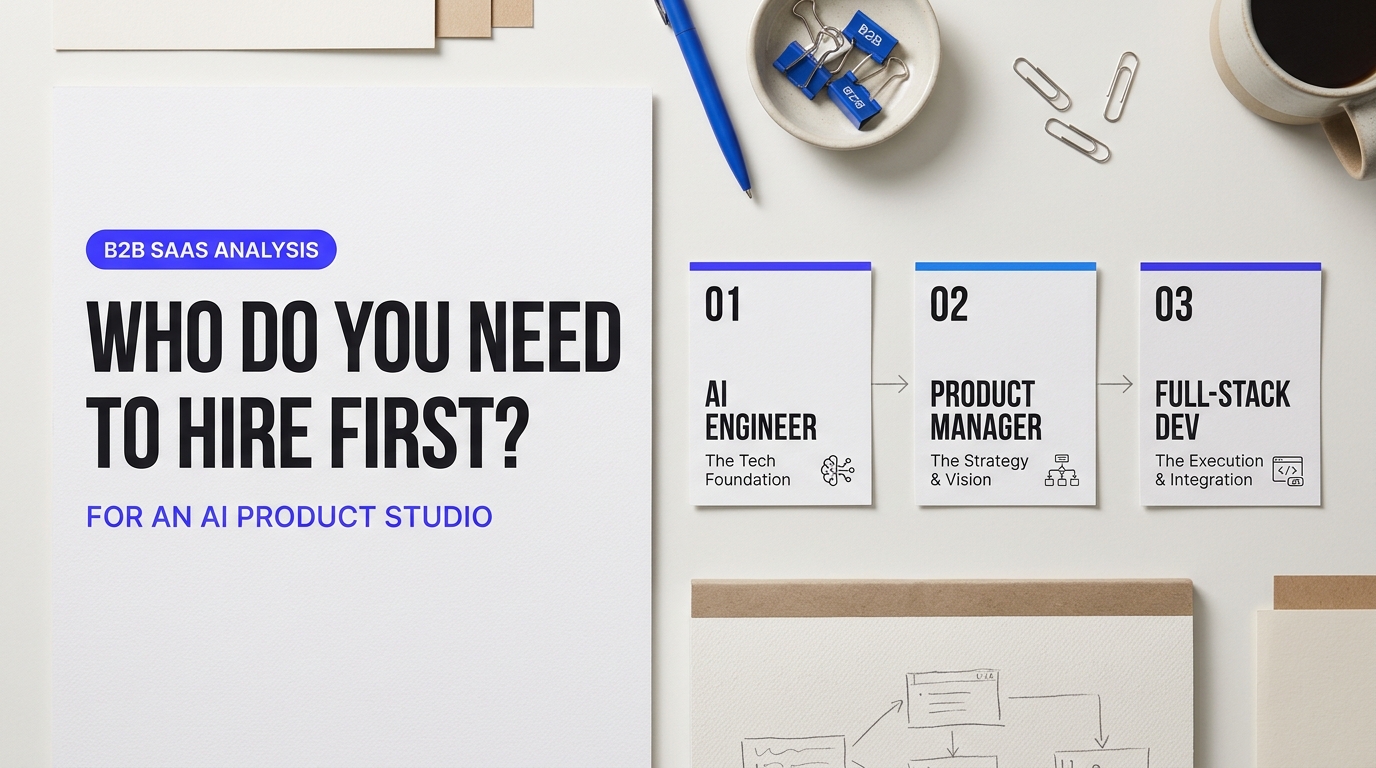
Most founders think they need a small army of machine learning researchers to get started. That is a costly mistake. If you hire a room full of PhDs to train proprietary base models, you will run out of money before you ever launch a product. Today's generative tooling lets small, lethal strike teams outpace 50-person engineering departments.
When you build an ai product studio targeting direct-to-consumer software, your hiring strategy looks completely different from a standard SaaS startup. You are not building one forever-company. You are building an idea factory that tests, launches, and spins out winners. That requires generalists who value shipping speed over theoretical perfection.
Core Roles to Build an AI Product Studio Strike Team
Your founding team needs four distinct profiles. In the first six months, you can run this entire operation with just two or three full-time people backed by targeted fractional support.
- The AI/ML Systems Engineer: Do not hire a foundational model researcher. Hire an applied systems builder. This person treats LLMs and diffusion models like APIs and databases. They understand prompt chaining, retrieval-augmented generation (RAG), vector storage, and model fine-tuning. They act like a master mechanic, making sure your tools don't hallucinate or rack up massive API bills. They live in evaluation platforms like LangSmith evaluation software to track accuracy and benchmark production prompts against latency limits.
- The Full-Stack Product Builder: You need an engineer who can spin up a production-ready Next.js web application, hook up Stripe billing, and build a smooth UI in 48 hours. In direct-to-consumer tools, user experience makes or breaks adoption. If a creative tool takes five confusing steps to generate an ad variant, users leave. This builder makes complex AI pipes feel completely effortless to non-technical users.
- The Fractional Growth Architect: Hiring a full-time Chief Marketing Officer on day one is financial suicide. Instead, bring in a growth lead for 10 to 15 hours a week. Their job is cold-testing demand. They run small paid ad tests on Meta and TikTok, set up pre-order landing pages, and talk to D2C store operators. They kill ideas that have no distribution pull before the engineering team writes a single line of backend logic.
- The Embedded D2C Domain Expert: AI outputs are useless if they miss the nuances of the industry. You need someone who knows how direct-to-consumer operators actually work. Where do their ad budgets leak? Why do customer support tickets spike in Q4? This can be an internal co-founder or an active industry advisor with skin in the game.
"Looking for genuine user experiences... How does the quality and output hold up compared to manual workflows?" — A frequent concern highlighted in Reddit SaaS community discussions on studio hiring.
The answer comes down to hiring people who know how to bridge the gap between messy prototype scripts and polished commercial software. If your team cannot ship continuous production updates, your studio will stall out at the demo stage.
| Role | Type | Primary Responsibility | Key Metric |
|---|---|---|---|
| AI Systems Engineer | Full-Time | Model routing, latency, output quality | Cost per inference & error rate |
| Full-Stack Builder | Full-Time | Rapid UI/UX, integration, MVP delivery | Time to first working prototype |
| Growth Lead | Fractional | Demand validation, early acquisition loops | Cost per waitlist signup / CAC |
| Domain Expert | Advisor / Fractional | Workflow mapping, problem discovery | Feature retention rate |
Incentive Models: Keeping Talent Glued to Studio Success
How do you stop your best builders from quitting when one specific spin-out takes off? Traditional startups give equity in one single entity. Studios can't do that. If your full-stack builder creates an automated product photography tool that explodes to $100k MRR, they will resent owning equity in a parent studio that holds four other failing experiments.
We solve this with a pooled incentive model. Team members receive base equity in the core holding company (the studio studio vehicle). On top of that, they get dedicated founder equity or profit points in the individual spin-outs they bring to life. If an engineer acts as the lead technical architect on a project that spins out into an independent business, their dedicated equity pool in that daughter company jumps to 5% to 15%.
Cross-allocating team members across several projects is dangerous if you let focus shatter. Context switching destroys productivity. The human brain hates jumping between e-commerce catalog syncs in the morning and social ad generators in the afternoon.
Run your team in sprints, not split shifts. Give the core team one single validation hypothesis for a two-week sprint. During that window, the growth lead and the engineer focus 100% on that single product hypothesis. If it hits its pre-agreed conversion benchmarks, it moves into build mode. If it flops, the team conducts a post-mortem, saves the reusable code snippets into your internal library, and resets for the next concept.
How to Build a Reusable AI Tech Stack and Shared Infrastructure
Most startup founders waste six weeks configuring authentication, payment processing, and database schemas before writing a single prompt. For a team building multiple consumer and direct-to-consumer (D2C) applications every quarter, that latency is lethal. If you want to test a dynamic product bundling assistant on Monday, you cannot spend two weeks configuring API gateways. Shared infrastructure turns your studio from an artisanal craft shop into an assembly line. When you build an ai product studio, your reusable software foundation becomes your primary competitive advantage.
Every product you spin out will need the exact same plumbing. They all need to authenticate users, manage API rate limits, store embeddings, trace prompt regressions, and protect customer data. Solving these engineering challenges once lets your product teams assemble prototypes in three days instead of three months.
Architectural Foundations to Build an AI Product Studio
Think of your shared stack as an operating system for launching software. Instead of letting engineers pick their favorite bespoke frameworks for each experimental brand, you enforce a single, battle-tested core architecture. This shared backbone consists of five modular services.
| Layer | Primary Purpose | Standard Tooling | Time Saved Per Launch |
|---|---|---|---|
| Routing & Orchestration | Model failover, cost control, caching | LiteLLM, Portkey | 1 to 2 weeks |
| Context & Vectors | Catalog search, memory retrieval | Qdrant, pgvector | 1 week |
| Evaluation Harness | Automated accuracy & regression tests | Promptfoo, DeepEval | Ongoing reliability |
| Telemetry & Logging | Token tracing, user session tracking | Langfuse, Helicone | 3 to 5 days |
| Guardrails & Safety | PII masking, brand tone enforcement | NeMo Guardrails, Lakera | 1 to 2 weeks |
Founders often wonder if setting up this central architecture is worth the initial investment. In an honest discussion on reusable AI infrastructure investment, developers pointed out that building custom wrappers often creates technical debt if the abstraction is too rigid. The goal isn't to build a proprietary monolith. You want lightweight microservices and modular boilerplates that allow your engineers to swap components without touching product logic.
The LLM Routing Layer: Cost Control and High Availability
Never hardcode direct provider calls into your application code. Models change weekly. Upstream providers suffer outages. Rate limits throttle conversion funnels.
A routing layer acts like an air traffic controller for your language queries. If an experimental D2C product uses Claude 3.5 Sonnet for creative ad copy generation and Anthropic suffers degraded performance, the routing layer automatically falls back to GPT-4o without dropping the user's session. It handles caching, rate-limiting, and semantic retries behind a single OpenAI-compatible interface.
Two tools dominate this space: LiteLLM and Portkey. LiteLLM is ideal if your studio prefers lightweight, self-hosted open-source software. You deploy it on your central cluster, point your client code to its local endpoint, and manage provider API keys from one environment file. Portkey is a managed alternative that brings deeper enterprise features. It offers visual tracing dashboards, budget limits per project, and multi-region routing out of the box. Pick Portkey if you want turnkey guardrails and analytics; pick LiteLLM if you want full data sovereignty.
Automated Evaluation Harnesses
How do you know that a prompt tweak designed to improve conversion on your skincare product doesn't accidentally suggest dangerous ingredient combinations? You can't rely on manual spot checks. Manual testing fails under real user loads.
An evaluation harness is like a crash test facility for your prompts. Before any change hits production, your continuous integration system runs your prompts against a "golden dataset" of hundreds of simulated consumer inputs. Tools like Promptfoo or DeepEval test your models for hallucination, brand voice consistency, latency, and factual recall.
"If you deploy prompt updates without an automated test suite, you aren't engineering. You're guessing with customer trust."
When an engineer updates the prompt structure for a virtual stylist app, the test suite runs automatically. It flags if the answers become too verbose or if the model drops below a 95% relevance threshold on product catalog retrieval. The deployment fails if quality degrades.
Vector Stores and Shared Knowledge Retrieval
Consumer applications live and die by personalized recommendations and deep product knowledge. You need a fast, reliable way to store and retrieve unstructured data like product catalogs, customer reviews, and sizing charts.
While managed services like Pinecone offer fast setup, many studios run into cost traps once their vector volume climbs across dozens of sub-brands. For studio operations, pgvector (PostgreSQL with vector support) is frequently the most practical starting point. It keeps your relational user data and vector embeddings in the exact same database engine. You don't need to synchronize two separate data pipelines.
For high-throughput applications requiring sub-10-millisecond semantic search across millions of SKUs, standalone engines like Qdrant shine. Qdrant provides advanced payload filtering, meaning you can filter products by price, brand, and stock status alongside vector similarity searches in a single query.
Centralized Telemetry, Identity, and Compliance
To successfully build an ai product studio that scales multiple startups, you need strict financial and legal isolation between your spin-outs. You cannot mix customer records or blend API spend.
- Authentication and Identity: Standardize on multi-tenant providers like Supabase Auth or Clerk. Every new project spins up under an isolated organization partition, sharing identical session-handling routines.
- Session Telemetry: Use tools like Langfuse to capture full execution traces. When an end-user gets a broken response, your team can inspect the exact prompt, retrieved context, system variables, latency, and token cost of that specific interaction.
- Automated Compliance Pipelines: Direct-to-consumer apps encounter sensitive user inputs, from credit card fragments to medical conditions. A shared compliance pipeline strips Personally Identifiable Information (PII) before queries ever touch third-party model providers. It prevents proprietary company data from leaking into model training sets and ensures your spin-outs comply with standard consumer privacy laws.
Investing four weeks up front to assemble this shared foundation changes the economics of early venture creation. It drops the marginal engineering cost of each subsequent release close to zero. Instead of debugging connection pools and routing rules for every new concept, your studio engineers spend their entire working week on the only metric that matters: product-market fit.
How Does an AI Product Studio Validate Ideas in Under 30 Days?
Most traditional venture builders spend six months and $200,000 proving what a seasoned growth marketer could discover in an afternoon: nobody wants the product. When you build an ai product studio for D2C brands or enterprise workflows, your primary asset isn't capital or custom model weights. It's cycle velocity. You run a triage engine designed to disqualify weak hypotheses before they burn through your engineering runway.
Foundational models make building software cheap. Because anyone can stand up an AI wrapper over a weekend, consumer inboxes and app stores are flooded with digital clutter. Your job during the first 30 days isn't to ship an operational micro-SaaS. You're hunting for acute pain, genuine willingness to pay, and durable retention hooks.
How to Build an AI Product Studio Idea Engine in Four Sprints
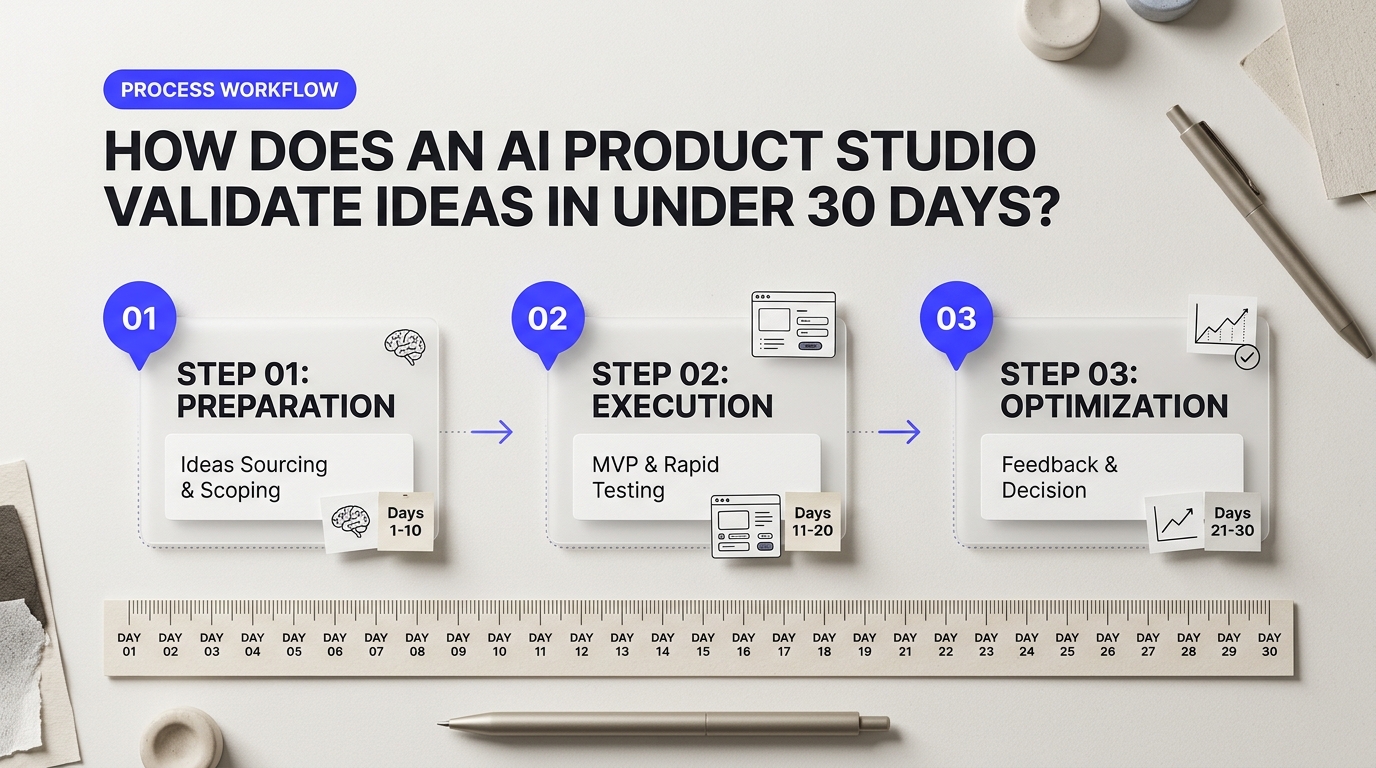
Every concept that enters your pipeline faces a strict 30-day timebox. If an idea fails to clear a quantitative hurdle at the end of any seven-day sprint, you discard it or send it back to raw ideation. No debates. No sentimental attachments.
Days 1 to 7: Fake Doors and Smoke Testing
Start with cold demand signals. Build a high-converting landing page using tools like Webflow or Framer that outlines the core value proposition as if the software already exists. Focus on specific, painful operational problems. In the D2C space, that could mean automated TikTok creative variations, dynamic margin-based pricing, or instant product returns mitigation.
Drive $300 to $500 in targeted paid search and social ads directly to this page. You aren't tracking simple email newsletter sign-ups. You're tracking high-intent friction actions: clicking a "Start 14-Day Free Trial" button, completing an onboarding questionnaire, or inputting credit card details for a pre-order reservation. If your conversion rate on high-intent actions sits below 5%, the value proposition lacks punch. Kill it immediately.
Days 8 to 14: Synthetic Stress Testing and Voice of Customer
Once human interest registers, subject the concept to synthetic stress testing before hiring developers. Using platforms like Synthetic Users alongside targeted customer discovery calls gives you a fast dual-track feedback loop. You run your value proposition, pricing tiers, and intended interface through a dozen calibrated synthetic personas representing e-commerce directors, performance marketers, or inventory planners.
Synthetic feedback doesn't replace real customers. It highlights obvious logical flaws, compliance tripwires, and user onboarding friction in minutes rather than weeks.
Take those synthetic stress tests and sanity-check them against five live interviews with operators. Founders in the Reddit SaaS validation debate often ask whether early automated workflows hold up to manual human output. These interviews answer that exact question. If prospective buyers say your automated concept solves an annoyance rather than a budget-draining emergency, stop digging.
Days 15 to 21: The Wizard of Oz Prototype
Don't build complex backend infrastructure yet. Avoid custom vector databases and intricate asynchronous queues. Build a lightweight frontend using rapid code generators like v0 or Lovable, wire it to an interface, and fulfill the backend work manually or via basic Zapier loops. If you're testing an AI product photography tool for Shopify merchants, let users upload assets through your interface, run them through Midjourney or ComfyUI workflows manually on your own workstation, and deliver the final assets within two hours.
The user experiences the core utility. You observe their behavior without writing thousands of lines of maintainable code. Instrument the prototype with an event-driven product analytics tool like PostHog product analytics to track session depth, user drop-offs, and repeated feature activations.
Days 22 to 30: The Retention Pressure Test
The final sprint measures organic pull. Turn off your manual prompts. Don't send pushy reminder emails. Watch what the cohort does on their own accord. Do they come back on Day 3 and Day 7 to run another task? Do they complain when the prototype encounters an error or goes offline?
| Validation Phase | Core Metric | Pass Threshold | Immediate Kill Trigger |
|---|---|---|---|
| Smoke Test | High-intent click-through / pre-order rate | > 5% from targeted traffic | < 2% or CPA > $80 on paid ads |
| Synthetic & Discovery | Willingness to pay (WTP) validation | 4 out of 5 human interviews confirm budget line | Categorized as a "nice to have" utility |
| Wizard of Oz | Task completion rate | > 70% of activated users input real operational data | Users bounce after initial login screen |
| Retention Sprint | Day 7 unprompted repeat usage | > 30% weekly task recurrence | Zero unprompted returns within 96 hours |
The Post-Mortem: Why Killing 80% of Concepts Is the Only Metric That Matters
Founders fall in love with their ideas. Professional studio teams fall in love with throughput. If you validate five concepts simultaneously and greenlight four of them, your validation gates are broken. The economics of an AI studio crumble the moment you allocate full-time engineering and product design talent to lukewarm propositions.
When an idea misses its Day 28 retention gate, archive the landing page, document the failure notes in your internal knowledge base, and return the allocated team member to the discovery pool. Scrapping a concept on Day 30 costs a few hundred dollars in ad spend and a couple of weeks of sweat equity. Scrapping that same concept after building a full-stack SaaS costs six months of payroll and misses emerging market windows. Move fast, measure ruthless intent, and pull the plug without remorse.
How Should You Structure Equity, Spin-Outs, and Investor Capital?
Spinning out an AI product isn't like selling software from an agency. When you spin out a project, you create a brand-new corporation with its own stock ledger, intellectual property rights, and commercial bank account. If you botch this transition, your product dies in legal purgatory before its first real venture round.
Every spin-out starts with an asset transfer. The parent company (HoldCo) invents the technology, tests it with D2C brands, and builds the initial model pipelines. Once the tool reaches product-market fit—say, an autonomous D2C email personalization agent making $15,000 in monthly recurring revenue—the studio transfers the code, domain, customer contracts, and weights to a fresh Delaware C-Corp (SpinCo). In exchange, HoldCo takes equity.
Cap Table Realities When You Build an AI Product Studio
Old-school incubators used to demand 60% to 80% of a company. That model is dead. If an outside venture capitalist looks at a cap table and sees that the incoming CEO owns only 20% at seed stage, they will walk away. Why? Because when the company hits hard times, a heavily diluted founder walks away too. Modern AI studios leave the incoming leadership team with meaningful control.
| Stakeholder | At Spin-Out (Day 1) | Post-Seed Round ($2M Raised) | Primary Role & Commitment |
|---|---|---|---|
| The Studio (HoldCo) | 30% – 35% | 22% – 27% | Supplies initial tech stack, shared data pipelines, early customers. |
| Recruited Founder/CEO | 55% – 60% | 40% – 45% | Drives commercial execution, customer acquisition, product roadmap. |
| Unallocated Option Pool | 10% – 15% | 8% – 12% | Reserved for early AI engineers and senior hires. |
| Seed Investors | 0% | 20% – 25% | Provides growth runway and balance sheet capital. |
You can track these ownership shifts using platforms like Carta or Pulley. Carta handles cross-entity equity portfolios smoothly, though Pulley tends to offer faster setup and lower fees for lean spin-outs that need immediate 409A valuations.
Funding the Engine vs. Funding the Car
One common mistake is trying to fund day-to-day studio payroll using product seed investments. That triggers massive corporate governance headaches. You have to separate how you fund the studio engine from how you fund individual cars.
You have two main paths to capitalize the whole operation:
- The Dual-Entity Model: You run a Studio HoldCo (operating company) alongside an affiliated Studio Fund (venture fund). Limited Partners (LPs) put money into the fund. When the studio validates an idea, the affiliated fund writes the first institutional check—typically $250,000 to $500,000 on a SAFE note. This funds runway for the spin-out's new team.
- The Balance Sheet Model: The studio operates as a single holding company funded through founder capital, agency service cash flows, or direct HoldCo equity investments. Every spin-out stays self-funded until an outside institutional investor leads an external round.
"The biggest trap is loading the spin-out with too much overhead debt from the studio. If the studio bills the project $300,000 in 'shared service fees' payable upon raising seed funding, outside investors will see right through it. They want their money funding growth, not paying back the studio's past rent."
As highlighted in discussions on studio equity models in r/SaaS, early founders frequently express frustration when studio terms look like predatory loans rather than true partnerships. Clean, transparent terms prevent those fights before they start.
Protecting Your IP During the Transition
Who owns the weights? Who owns the scrapers? What about the training pipeline?
When you build an ai product studio, you'll reuse internal components across several products. For example, your custom data-cleaning module for D2C Shopify catalogs might power three different tools in your studio. You can't give exclusive ownership of that core engine to one single spin-out.
Use a split intellectual property agreement. The studio signs an Exclusive IP Assignment for all product-specific assets: UI code, trained model weights tuned specifically for that problem, trademarks, and customer databases. Meanwhile, the studio grants the spin-out a Non-Exclusive, Perpetual, Royalty-Free License to the shared base infrastructure. This keeps your shared studio toolkit intact while giving the spin-out clean legal ownership that satisfies any venture capital diligence team.
How Do AI Studios Protect Their Products From Fast Commoditization?
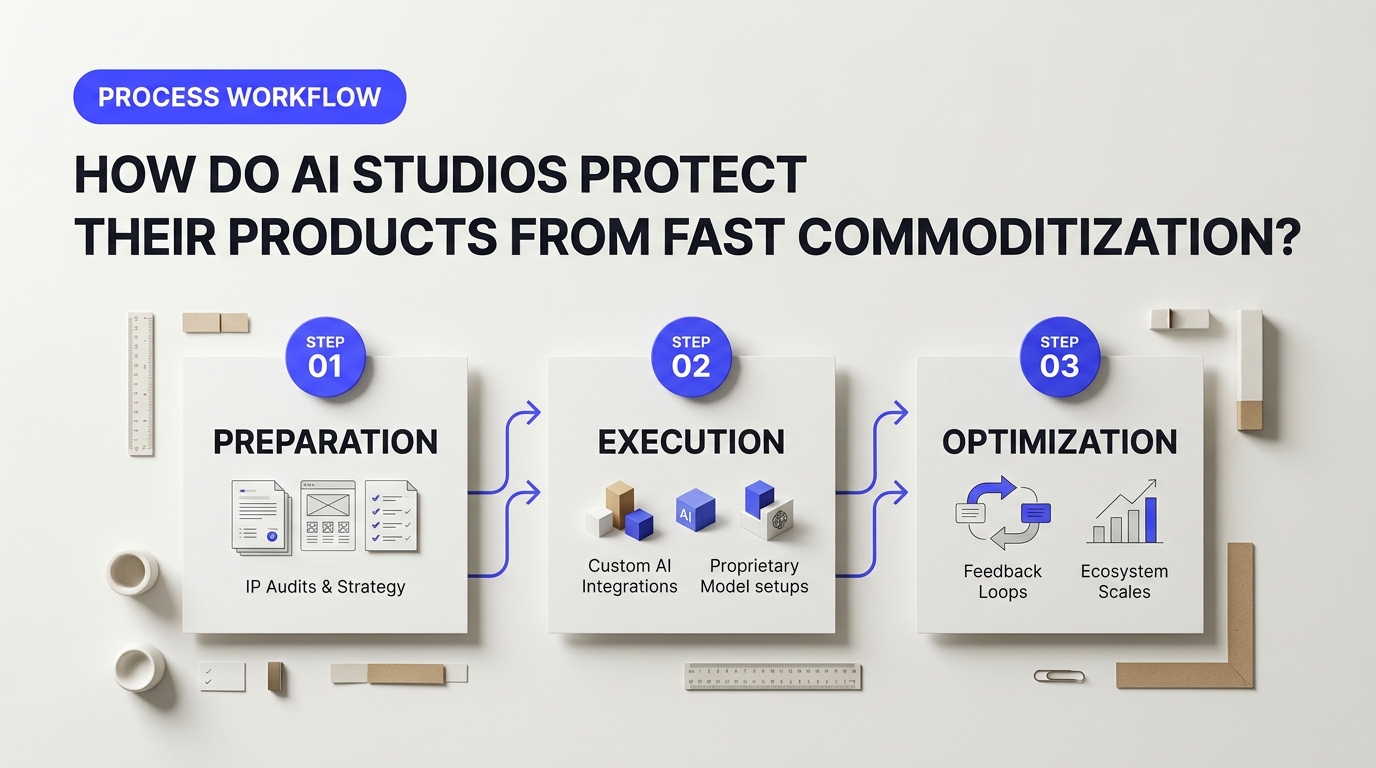
Base model providers launch updates every few months. When OpenAI or Anthropic drops a new feature release, dozens of single-feature startups die overnight. If your software is just an API call wrapped around a clever system prompt, you have zero defense against platform updates. A founder recently highlighted this anxiety during an honest SaaS discussion on AI product commoditization, questioning whether outputs from automated wrappers hold up against real manual workflows over time. Surviving this reality means viewing foundation models as cheap electricity. Your product is the specialized industrial machine powered by it. When electricity gets cheaper and faster, your machine should perform better, not go out of business.
Moving Beyond Thin Wrappers When You Build an AI Product Studio
Every concept your studio validates must solve an operational bottleneck rather than showcase an AI capability. When you build an ai product studio, prompt engineering isn't a long-term moat. Prompts leak, competitors copy them, and frontier models absorb them into system defaults.
Defensible studios focus on building products that become harder to rip out the longer a customer uses them. You achieve this by shifting value away from the model generation layer and into system coordination, proprietary data loops, and deeply entangled daily workflows.
Four Structural Moats That Outlast Foundation Model Updates
Studios avoid commoditization by engineering defenses across four distinct layers of the software stack:
- Proprietary Vertical Data Flywheels: Foundation models train on public web scrapes. They don't know the exact click-to-purchase ratios of direct-to-consumer ad variations across specific European markets. They don't have access to your private return-log records or supply-chain discount schedules. When a customer uses your tool, their actions, manual corrections, and performance outcomes feed an internal feedback loop. That specialized operational data belongs entirely to you.
- Deep Workflow Integration: Software that sits inside existing habits doesn't get replaced easily. If your AI tool automatically reads incoming customer support messages in Gorgias, pulls tracking updates from ShipBob, cross-references inventory levels in Shopify, and drafts custom replies, removing your software breaks four internal departments. The connections between the databases create the moat, not the language model.
- Private Agent Orchestration: Simple tasks take one prompt. High-value business operations require dozens of structured steps. Reliable products use deterministic code to guide flexible AI agents through complex trees. One agent extracts order discrepancies, a validation block calculates inventory margins against strict rules, and a final agent formats a vendor notification. The logic chain handles messy edge cases that single model prompts choke on.
- Enterprise-Grade Security and Governance: Growing brands and large retailers worry about data leakage. They want guarantees that their proprietary sales trends won't train public models. Studios build defensive value by shipping zero-data retention agreements, custom field-level PII redactions, and SOC2-compliant access logs. Enterprise teams pay for compliance confidence as much as the feature itself.
"The moat isn't the model. The moat is the friction required to replace your software once it lives across five internal databases."
Observability Stack: LangSmith vs. Langfuse for Moat Maintenance
Models drift. Prompt performance changes. New base model versions can unexpectedly degrade output formatting. Maintaining defensible agent orchestration requires deep tracing into what happens under the hood.
Two primary platforms lead production observability: LangSmith and Langfuse. Both let teams log execution runs, track prompt latency, monitor token spend, and build automated regression testing benches.
| Capability | LangSmith | Langfuse |
|---|---|---|
| Core Positioning | Native debugging suite tailored for LangChain and LangGraph agent pipelines. | Open-source, model-agnostic LLM engineering and observability platform. |
| Hosting Model | Cloud SaaS and dedicated enterprise instances. | Self-hosted open-source or managed cloud deployments. |
| Studio Use Case | Best for engineering teams shipping deeply coupled Python multi-agent state machines. | Ideal for studios requiring strict data residency, privacy control, and self-hosted instances. |
| Cost Profile | Seat-based pricing with usage tiers; can scale up quickly across multi-project teams. | Cost-effective self-hosting; pay only for actual underlying server resources. |
Choosing between these platforms comes down to your studio's operational architecture. If your builders rely heavily on Python-based graph workflows, LangSmith gives you instant trace visibility without custom setup. If your portfolio companies serve privacy-sensitive retail brands needing local data storage, Langfuse gives you full self-hosted control.
The main mission when you build an ai product studio for D2C brands is making sure the AI acts as an invisible, reliable engine. Keep your user interfaces focused on business outcomes: inventory saved, margins preserved, and hours returned to teams. When customers purchase measurable operational efficiency, base model price wars become an advantage for your balance sheet rather than a threat to your business.
Scaling Your Studio Engine: From First Launch to an Enduring Portfolio
Launching your first three generative tools feels exciting. Turning those early experiments into an enduring portfolio is a completely different fight. When you decide to build an ai product studio for D2C brands, your biggest obstacle isn't token limits or foundation model updates. It's organizational friction. Teams often stumble by treating their studio like a loose collection of disconnected side hustles rather than an integrated production line.
As operators frequently highlight in Reddit debates on studio portfolio economics, a massive concern is whether the studio layer adds unnecessary overhead compared to traditional startup paths. The investment only pays off when your core operational assets compound. Every customer acquisition pipeline, automated prompt evaluation framework, and commerce integration you build for your first product must directly reduce the launch cost of your fourth.
Milestones to Build an AI Product Studio for Long-Term Scale
Scaling past the initial launch phase requires shifting focus from raw experimentation to standardized delivery. Successful studios navigate this transition by hitting three distinct milestones:
- Centralizing Shared Observability: Don't let individual portfolio teams reinvent basic infrastructure. Standardize your AI stack early. Many studios debate between platforms like Helicone and Langfuse to track cost and model behavior. Helicone excels at raw edge caching and lightweight proxy logging, which keeps API bills low across high-volume consumer workflows. Langfuse offers deeper application tracing and human-in-the-loop evaluations. Standardizing on Langfuse gives your centralized product team unified visibility into error rates, user feedback, and prompt drift across every active e-commerce application.
- Systematizing Founder Transitions: Studio builders shouldn't run spun-out companies forever. Staying in the weeds as an interim CEO chokes your ideation pipeline. Once a prototype proves market demand—typically crossing a consistent baseline of recurring sales or active merchant subscriptions—bring in a dedicated founder or general manager to steer growth. Hand over the day-to-day operations cleanly, keep a minority equity stake, and point your core creative engineers back at the validation queue.
- Recycling Technical Scraps: Most startup experiments fail. In an independent venture, a failed business means zero return on capital. In a studio, every abandoned project leaves behind reusable pieces. Failed checkout personalization models, fine-tuned consumer copy engines, and Shopify connector scripts should go straight into your internal repository. Your developers can pull these modular blocks into the next prototype within hours.
The true moat of a venture studio isn't the brilliance of its first hit. It's the compounding speed at which it can test, validate, and spin out the next five.
Velocity remains your best defense against rapid commoditization. Direct-to-consumer software moves quickly, and off-the-shelf foundation models get smarter every quarter. By treating your studio infrastructure as an evolving assembly line rather than a series of one-off projects, you preserve your speed, protect your margins, and turn isolated experiments into a profitable, enduring portfolio.